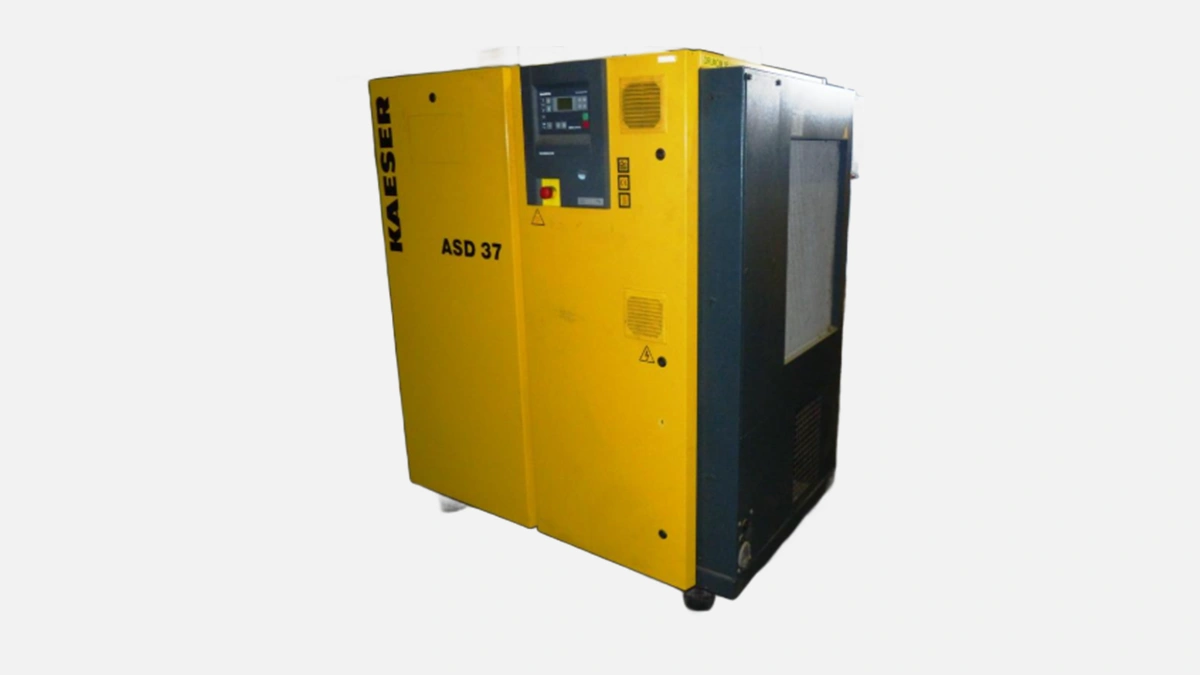
37 kW rotary screw compressor delivering 6.4 m³/min at 7.5 bar, proven to stay cool in Gulf heat.
Short intro. Blink and you miss it. The beige cabinet sits there, square, nothing dramatic. Yet many shops in Dubai swear by it, and not just because the logo looks neat. They need air, stable 24/7. The ASD 37 just does it.
Right, before opinions overflow, hard numbers anchor the talk. A stock ASD 37 with the Sigma profile rotors pushes roughly 6.4 m³/min at 7.5 bar, climbs toward 5.9 m³/min once you move to 10 bar, and, yes, drops a bit further near 13 bar. That curve is typical for any oil-injected rotary screw, nothing spooky. The internal gear coupling keeps the rotor speed matched to the motor, so no belts to retension every quarter.
We can place the main figures in a compact view, easier on the eyes.
| Item | Value | Field note |
|---|---|---|
| Motor rating | 37 kW | Standard IE3 efficiency |
| FAD at 7.5 bar | 6.4 m³/min | Lab data ISO 1217 Ann. C |
| Noise | 69 dB(A) | Measured at 1 m free field |
| Oil carry-over | < 2 mg/m³ | With KAESER filter pack |
| Specific power | 6.4 kW/m³/min | Not the best, not the worst |
| Cooling flow | 4 200 m³/h | Side discharge |
Tables help, fine. Yet they hide the story. The bigger point is consistency. Shops running laser cutters hate sudden dips in pressure because the cut edge goes nasty instantly. The Sigma Control 2 brain keeps the pressure ripple inside ±0.1 bar, good enough that most line regulators hardly flinch.
Hot Gulf afternoons roast many compressors alive. The ASD 37 ships with a radial fan rated for 45 °C ambient. Users in Sharjah who dare push it inside a poorly ventilated corner still manage to stay under 95 °C oil temperature according to the log files I glanced at last month. Once the summer north wind loads the inlet with fine dust, the oversized panel filters show their worth, no marketing fluff, just less downtime.
After maintenance you wipe the fins, touch the housing, it remains warm but never scalding. Good for safety audits.
Open the right-hand door, a blue backlit screen blinks at you. That is Sigma Control 2. Navigation is like an ATM menu, four arrows, an Ok key, no smartphone needed. A Modbus-TCP card slides in if the plant already runs on SCADA. People ask whether the panel survives brownouts common in older industrial zones of Ajman. It does, thanks to a buffered 24 V rail that rides through 200 ms dips.
Yes, firmware can be flashed onsite, a normal USB stick works. No rocket science.
The service interval is officially 4 000 h or yearly, whichever first. Reality check, firms running double shifts reach that in six months. Consumables list is short, roughly three items: separator cartridge, oil filter, intake element. The S-460 fluid holds viscosity better than plain ISO 46 mineral, so oil change sticks at 8 000 h. That halves the drum count over five years, not trivial money in the Gulf where disposal fees climb steadily.
Competitors like the Atlas Copco GA 30+ or the Ingersoll Rand R-37e dance in the same power slot. Quick scoreboard:
| Feature | KAESER ASD 37 | GA 30+ | R-37e |
|---|---|---|---|
| FAD at 7.5 bar | 6.4 m³/min | 6.2 m³/min | 6.1 m³/min |
| Noise | 69 dB(A) | 70 dB(A) | 71 dB(A) |
| Oil carry-over | <2 mg/m³ | 3 mg/m³ | 3 mg/m³ |
| Controller language set | 30+ | 18 | 12 |
| Warranty years (base) | 5 | 3 | 3 |
Numbers look close. The detail winning jobs in Abu Dhabi tends to be the longer warranty and the callout response, KAESER keep a parts hub in Jebel Ali so seals land overnight.
The broader ASD range runs from the 30 kW ASD 30 up to the 55 kW ASD 60. Flow scales almost linearly, but frames stay the same footprint. The 37 sits in the sweet spot, enough air for three medium CNC lathes plus the blow gun stations, but still on a 1.8 m length, meaning it fits between two mezzanine columns without core drilling. If you ever need more air, the ASD 60 bolts right next to it, pipe headers align, no rework.
One machine shop near Al Quoz runs two ASD 37 units in a lead-lag scheme. The lead one idles down at 70 % load around midnight when the laser beds cool, then the controller swaps duty at 6 a.m., so wear levels out. Their maintenance log shows rotor bearings swapped only once at 46 000 h, pretty solid run. Contrast that with an older belt-drive unit they retired, pulleys cracked twice in four years.
Power draw under full load sticks near 36.8 kW according to a Fluke clamp meter. At Dubai DEWA tariff of roughly 0.32 AED/kWh, yearly energy for 6 000 h sits around 70 000 AED. Drop pressure by 1 bar and you win roughly 6 % power saving, real life tested not brochure talk.
They all circle back to one thing, predictable uptime. Not glamorous, simply necessary.
The KAESER ASD 37 blends respectable flow, quiet operation, and a controller that even night shift staff understand. The frame has stayed mostly unchanged for three generations, roughly 15 years on the market, so spare parts catalog is mature. In plain words, you bolt it down, wire it, forget it until the hour meter blinks.
That is why many metal workshops between Abu Dhabi and Ras Al Khaimah quietly pick the beige box when the old piston units finally quit. No fireworks, just compressed air every single morning.