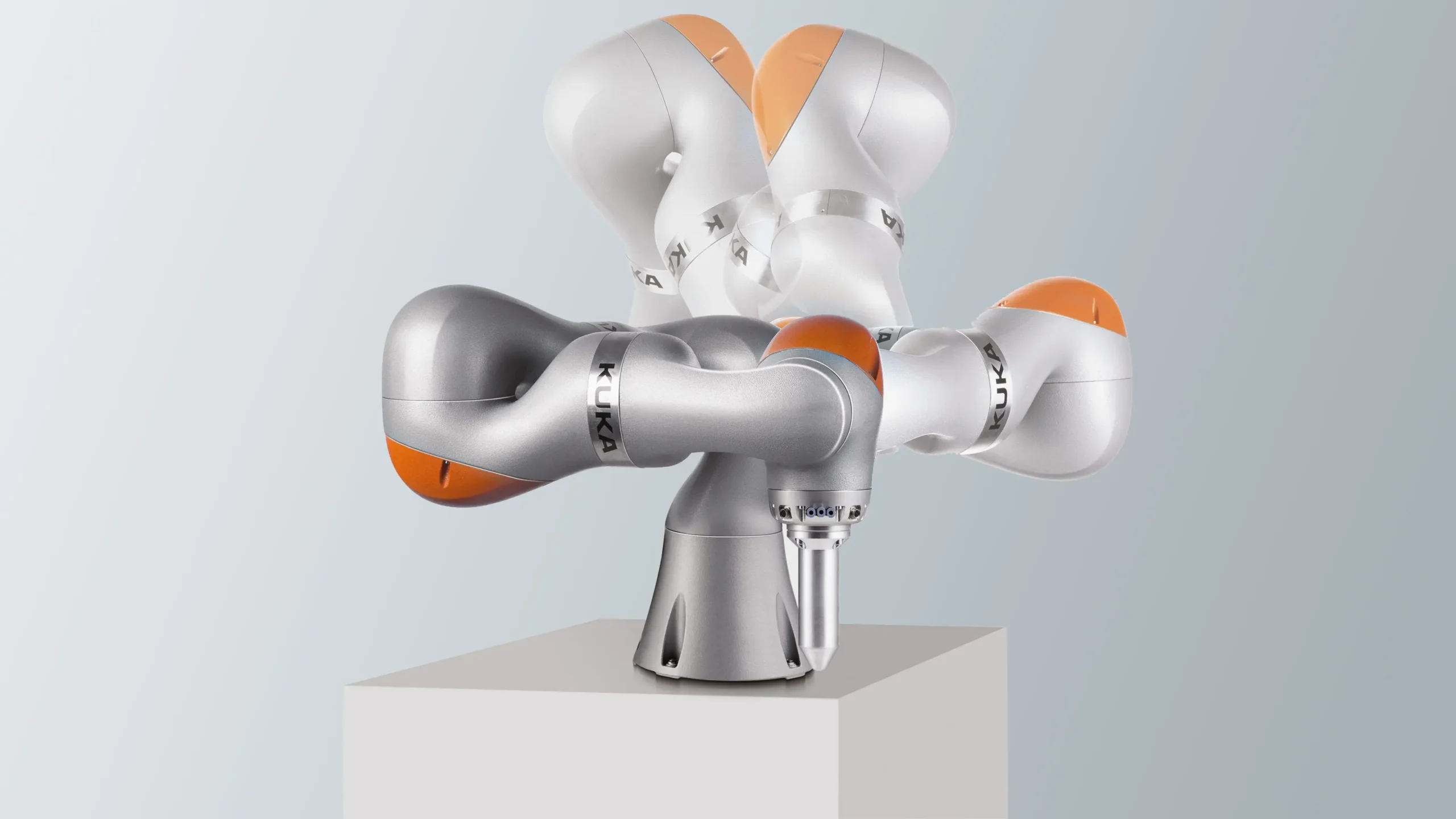
Lightweight 7-axis KUKA cobot with 7 kg payload and 0.1 mm repeatability for safe part handling
KUKA has been shipping articulated arms for over 40 years. Short. Direct. The LBR iiwa though, yeah, it came later, mid-2013 if memory does not fail. Suddenly cobots were not a lab toy any more, they stood by the press brake and did real work.
The name is a mouthful, I know. Leichtbauroboter Intelligent Industrial Work Assistant. No one in the shop says it that way. They just mumble “iiwa” and move on. What matters is what the arm does in the heat and dust of a UAE fab, not how the marketing team spells the acronym.
It is skinny. 23.9 kilograms for the 7-axis version, that is lighter than a single sheet of 8 mm mild steel the guys feed into the plasma table every morning. The low weight means you can pull the robot off the bench, bolt it to a cart, roll it next to a CNC lathe, and by noon it is doing part unloading with no fuss. The torque sensors are built into all 7 joints, so the arm feels when it touches something it should not. Operators relax, insurance company smiles.
Before diving into jobs and tricks, a plain table with cold numbers never hurts.
| Axis | Range | Max torque |
|---|---|---|
| A1 | ±170° | 120 Nm |
| A2 | 120° | 120 Nm |
| A3 | 170° | 70 Nm |
| A4 | ±190° | 32 Nm |
| A5 | 120° | 32 Nm |
| A6 | ±190° | 32 Nm |
| A7 | ±270° | 12 Nm |
Noticed the bold digits, right. The ranges are more than enough for screw-driving inside an aluminum frame or picking parts from a rotary table. Couple those values with a repeatability of 0.1 mm and you get fine positioning without touching a laser tracker every two hours.
Two quick bullets, just to break the monotony, but first a sentence to warn you. The cobot world loves bullet points, people feel they are reading fast.
We pause. Breathe. Then keep rambling.
The iiwa no longer needs the bulky KRC4 cabinet. It lives on the compact Sunrise Cabinet, about the size of a carry-on. That matters when floor rent in Dubai costs more than coffee at the marina. Power draw stays below 1.0 kW most of the time. Your facilities guy will not run a new three-phase feeder, a plain single-phase 220 V outlet does the job.
ISO 10218-1 compliance is the boring sentence you show auditors. The juicy bit is contact detection under 20 ms. Pull the arm, it stops. Push again, it cooperates. No cage, just a light curtain by the pallet if corporate insists. Less steel, less drilling, quicker sign-off.
We switch context. Imagine a job shop in Sharjah, medium batch, not automotive tier-one grandiose. They grab the LBR iiwa for repetitive but delicate moves.
Each task shares one pattern, the need for light touch without baby-sitting. The iiwa delivers just that. No miracle, just torque sensing every joint and 1 kHz internal loop.
Competitors? Sure, market is crowded. Here is a raw view, no sugar coating.
What stands out for iiwa is the fully integrated joint torque feedback in all axes, not just at wrist. That is why it excels at compliant insertion tasks like pushing a plastic clip into a die-cast housing without smashing it. The others fake it with software.
There are two native versions. The 7 R800 and the 14 R820. Same skeleton, different motor packs. If your spindle motor on the milling center rarely sees parts above 4 kg, go with the 7. The 14 carries a heavier EOAT but weighs a bit more and costs more to ship. Switching later is not trivial because arm inertia tables change, so pick right from the start.
First time set-up, you attach the mating plate using four M8 bolts, hook the data cable, power cable, Ethernet. Sunrise.OS pops up, you run the wizard, define TCP and load. Whole ritual fits inside one morning even if the installer drinks too many karak teas. For fieldbus, PROFINET and EtherCAT come standard, no extra boards.
The code side, Java API. Sounds frightening, actually quite readable. You write:
moveAsync(ptp(home).setJointVelocityRel(0.4));
and the robot jogs. Shop guys spot curly braces, groan a minute, then copy paste templates and carry on.
Grease change every 20 000 hours, filter swap every 5 000. No hydraulic leaks, no bellows. Firmware updates land over USB stick. A tech with a torque wrench and patience covers most tasks. Local service crew in Dubai reports median MTTR below 3 hours for encoder replacement.
Let me throw one more bullet list, I feel the urge.
Of course nothing is perfect. The cabling kit from axis 6 to axis 7 can twist after 1 million cycles if you pick a too stiff hose. Happened in Abu Dhabi, they replaced with softer PUR sleeve, kink issue gone. Keep that in mind.
Medical device assemblers, because fingerprints on titanium implants ruin passivation. Educational labs at Khalifa University, because open control API suits research. And plain sheet-metal subcontractors who just need a polite helper that never calls in sick during Eid.
KUKA ships roughly 4 000 cobots a year, iiwa takes about 20 percent of that pie. There have been three hardware revisions, latest adds upgraded encoders with 17-bit resolution. The lineage gives confidence that spare parts will not vanish next month.
All the talk, graphs, and footnotes could be shorter. Yet the essence remains: the LBR iiwa handles light, precise, touch sensitive tasks without cages or drama. That single trait saves floor space and time and fits perfectly with the flexible, small-batch vibe many UAE shops live by.