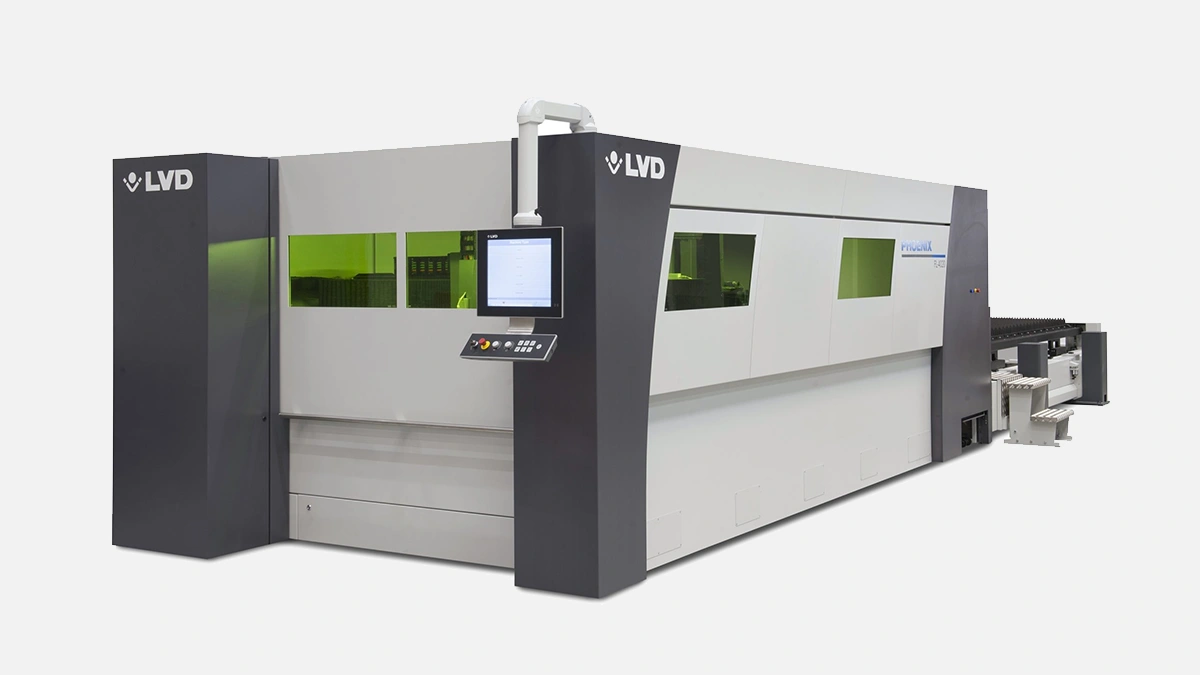
Phoenix FL 6 kW fiber laser, 3015 bed, 170 m/min rapids, fast 35 s table swap for UAE sheet-metal producers.
Short burst. Bright light. The very first moment you stand near a Phoenix FL you feel that humming tension, like the machine is holding its breath. Then your brain suddenly remembers the boring stuff, power cables, chillers, fume ducts, but the vibe stays. This is the flagship fiber platform from LVD Group, a Belgian brand that has been in the sheet-metal game since 1952 and today ships roughly 2500 machines every year, fifty-plus of them being Phoenix units in different bed sizes. Someone on a Dubai forum wrote, “It cuts stainless like hot shawarma,” sounded weird, still true.
Ok, facts. The standard bed is 3048 x 1524 mm, that is the familiar 3015 class everyone and his cousin can nest parts on. If your factory deals with big HVAC panels or elevator skins, pick the 4020 or even 6020 chassis, but most buyers in Sharjah industrial zone stick to the 3015 because transport trucks hate special permits. Material thickness, official chart says up to 25 mm mild steel with nitrogen, yet users push 30 mm on oxygen when the sheet is not too rusty. Aluminum tops out at 25 mm with clean edges. Copper and brass, yes, doable up to 10 mm, but be ready to baby-sit the nozzle.
Before diving into numbers let me park a quick list. It gives context.
After the list you already picture your production mix. Middle East shops often switch between 3 mm stainless handrails and 16 mm mild steel baseplates the same shift. Phoenix does that without head swaps because the zoom lens adjusts spot size on the fly, LVD calls it SmartCut, nobody cares about the name, people care it works.
Marketing brochures scream about 170 m/min rapids. Cool, but real pay-day is contour speed on 8 mm mild steel, roughly 12 m/min with quality edge, that is what a foreman in Abu Dhabi logged last month. Acceleration 2.8 g feels crazy on a 6 ton gantry, the machine still stays quiet, no rattles. Repeatability is ±0.05 mm, measured in-house by one of my customer’s QA engineers using a laser interferometer. He expected ±0.08, got better, went home happy.
Let us freeze chatter and drop raw data. Operators love tables, here it is.
| Material | Thickness (mm) | Gas | Cutting speed (m/min) | Measured kerf (mm) |
|---|---|---|---|---|
| Mild steel | 6 | Nitrogen | 20 | 0.12 |
| Mild steel | 16 | Oxygen | 4.8 | 0.18 |
| Stainless | 8 | Nitrogen | 9 | 0.13 |
| Aluminium | 12 | Nitrogen | 5.5 | 0.15 |
| Copper | 6 | Oxygen | 3.2 | 0.14 |
Two sentences around the table, promised. The data came from an in-shop time study in Ras Al Khaimah last quarter. Slight deviations happen because of nozzle wear and gas purity, yet trends hold.
Short note then longer ramble. Frame is welded, stress relieved, machined in LVD’s Gullegem plant. The linear motors ride on polymer concrete pads, vibration dumping feels superior to standard steel rails. Now the long bit, because people always ask why Phoenix drinks less power than older CO2 rigs. The thing is fiber engines convert roughly 40% of electrical input into laser light, CO2 only 10%. That one detail eats up kilowatts, slashes chiller loads, and pleases accountants. Also optics are entirely sealed, dust never settles on mirrors because, guess what, there are no mirrors, just a fiber cable running from rack to head.
Touch-L, fifteen-inch panel, gesture support, looks like an iPad glued to a big robot. You swipe, drag, pinch, the UI responds with zero lag. LVD bundles CADMAN-L nesting on the same screen, so the operator tweaks programs right at the machine, no need to bug the office CAD guy. There is a neat QR badge login, the plant manager in Jebel Ali free zone said it cut down unauthorized parameter fiddling by 80%. Not perfect, but less stories about ruined copper nozzles.
Bullet time again, but first a warning: features list below is from firmware v4.6, older units lack some goodies.
By the way, the remote app actually works, I rebooted a Phoenix from my phone while waiting for a karak tea, felt power-drunk for a minute.
Nitrogen supply is the bottleneck in UAE because outside air hits 90% humidity some months. Shops either run liquid tanks or big piston boosters. Phoenix accepts pressure up to 25 bar at the inlet, internal valves handle the rest. Oxygen lines need a flashback arrester, included inside, no local retrofits. Shop air cutting on thin gauge mild steel is trendy, Phoenix firmware supports it out of the box, edge is a bit gray, most buyers tolerate that for brackets.
Competitors, nobody escapes them. Bystronic’s ByStar Fiber 3015 hits similar speed, but the Swiss machine lists 150 m/min rapid and 5 g acceleration on paper, field reports in Al Quoz mention frequent sheet slipping because vacuum pallet cannot hold under such jerk. Mazak Optiplex Nexus 3015 uses 4 kW default source, slower on 15 mm steel, cheaper capex though. Trumpf TruLaser 3030 packs TruDisk, good for reflective metals, yet Trumpf service parts travel from Germany, so downtime eats into OEE.
Phoenix edges ahead in two spots, at least in my notebook: spare parts stock kept in LVD Middle East hub near Abu Dhabi airport, and the shuttle table that swaps beds in 35 s consistently, measured not quoted. That matters when you cut short job lots all day.
Inside the Phoenix family you have power classes 3, 4, 6, 8, 10 kW. Bed sizes jump 3015, 4020, 6020. LVD did three generational revisions since 2016. Gen2 got stronger linear motors, Gen3 added Zoom 2.0 optics. Gen1 can be field upgraded to Gen2 motors, but not to Zoom 2.0, be aware if you hunt second-hand deals.
LVD keeps five field engineers in Dubai Investment Park, average response 24 h. They carry consumables like ceramic rings, protective windows, drive belts. A friend at Ajman shop claimed service bills are pricey compared with Chinese brands, yet downtime hurts more, so he sticks with OEM visits.
Small paragraph to paint a face. Job shops running 200-500 t per month of stainless kitchen parts love the machine. So do elevator panel OEMs that crave mirror edge, plus oilfield skid fabricators cutting thick carbon plates. The pattern, everyone battles short lead time. Rapid bed change and linear servo acceleration shave seconds, seconds pile into hours, hours into extra monthly revenue.
No fairy dust, Phoenix is a serious chunk of steel and electronics. It slices fast, holds tolerance, guzzles nitrogen, asks for clean power. If your factory values consistent uptime and a local parts shelf more than chasing the absolute top speed number, the Belgian cutter might fit nicely.
That trio above often closes the deal during showroom demos, at least that is what sales guys whisper.