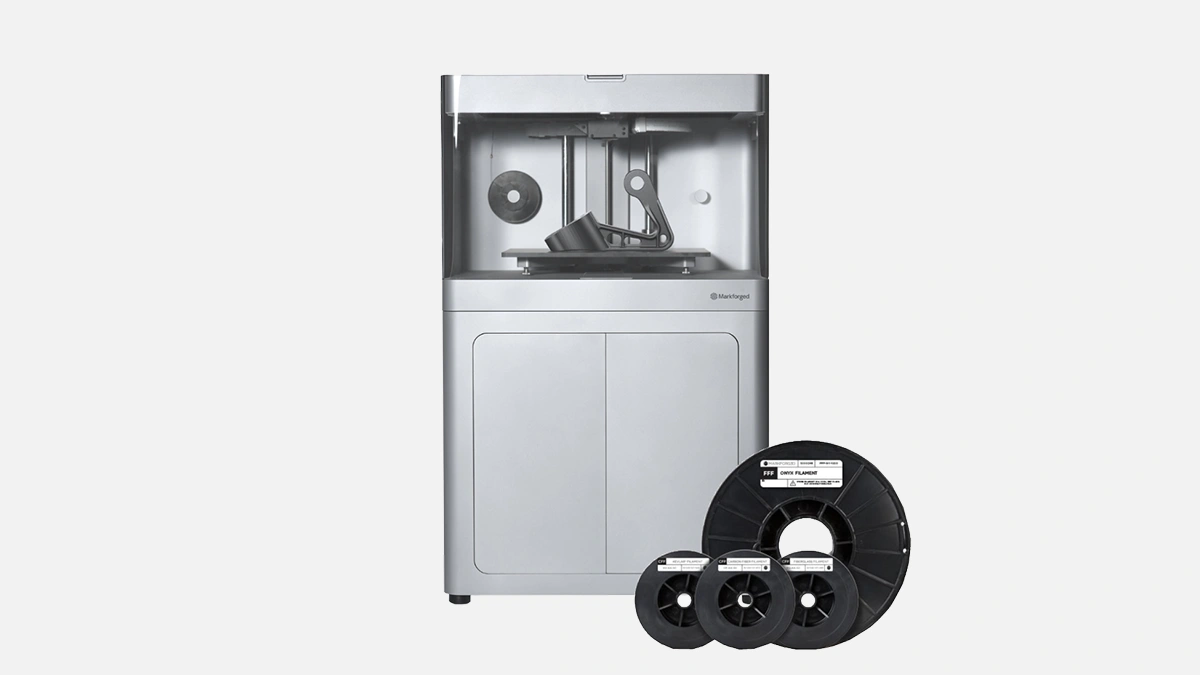
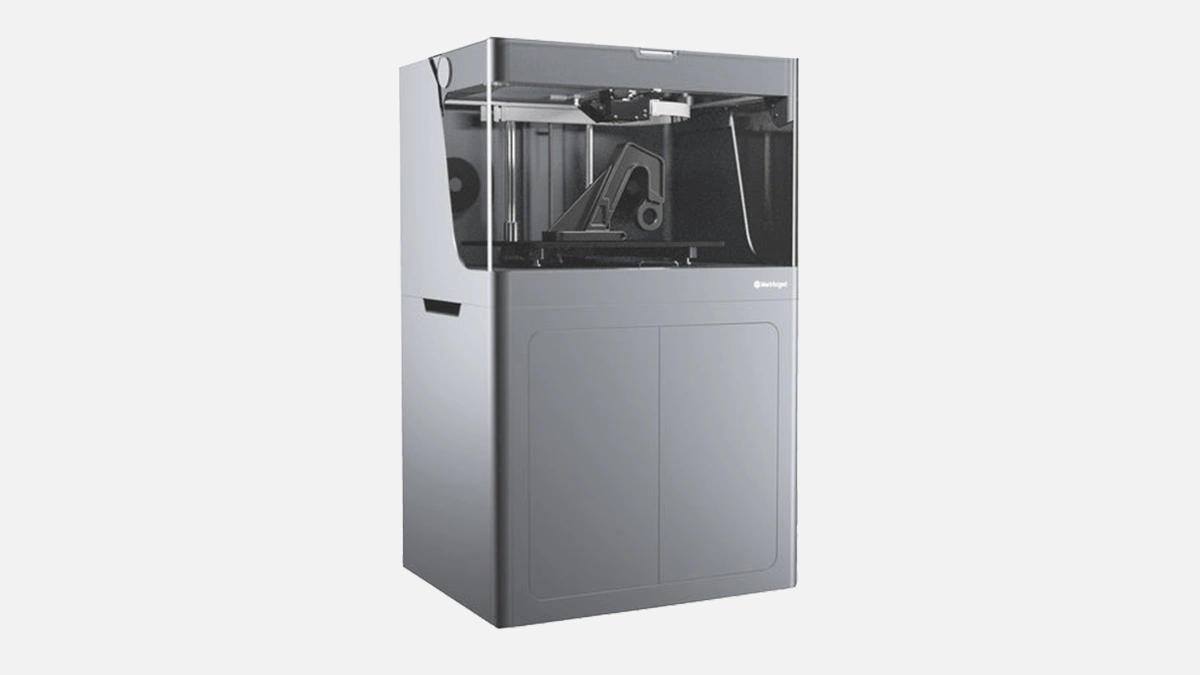
Markforged X7 prints carbon fiber-reinforced parts 330×270×200 mm, shop-floor ready in one shift.
Short sentence, then another. Sharp shift. You walk into a fab shop in Sharjah, noisy fans, smell of coolant, and there it is, the Markforged – X7, glossy black, kind of stealthy. Someone waves a wrench, says the machine just spat out a carbon fiber end-of-arm gripper and it fits straight on the robot. No sanding, no drama. I nod, pretend it is no big deal, inside I am impressed. But let us slow down.
The brand has been around since 2013, roughly ten years plus change, pumping out composite printers by the thousands every year, seven core models today, three generations of the X7 alone. That matters because parts, firmware updates, and spare extruders keep coming, you do not end up with orphan hardware.
Everyone talks about metal, yet half the fixtures on a machining line never see a cutting edge. Soft jaw inserts, CMM nests, pick-and-place fingers, rinse and repeat. Aluminum works, sure, but you machine it, deburr it, wait. The X7 hits print, drinks power like a kettle, drops Onyx, reinforces with carbon, done before night shift starts. Strength hits 800 MPa tensile when the continuous fiber runs the load path. That is steel territory, weight nowhere near.
Now a quick table, because numbers calm the nerves.
| Metric | X7 | Comment |
|---|---|---|
| Build volume | 330 × 270 × 200 mm | Fits a gearbox housing for a 5-axis trunnion |
| Continuous fiber | Carbon, Kevlar, Fiberglass | Pick by stiffness or impact resistance |
| Surface finish | 3.2 µm Ra after print | No post needed for most jigs |
| Layup speed | 150 cm³/h Onyx | With 0.2 mm layer |
| Inspection | Laser probe 1 µm | Checks every layer live |
The table sits here, but do not stare too long, look around. Two sentences later, we shift again.
You drop a STEP file into Eiger, the cloud slicer, tick how many carbon rings you want around each hole, hit print, walk away. The printer checks itself – bed leveling, nozzle heat, fiber path. No manual tweaks, no baby-stepping Z, no drama. Operators in Ajman who grew up on Haas mills say it feels like running a phone app, not a CNC.
Before bullets, breathe. Enterprises in Dubai Free Zone calculate everything in dirhams per minute. The X7 slides into that metric because it skips toolroom queues.
The list ends, but the thought keeps echoing, right.
Another bullet set coming, give context. The printer uses Onyx for the shell, that is nylon with chopped micro carbon, matte black, temperature rating 145 °C short term.
Each line hints at a different workshop scenario. After the list, let us pivot.
Markforged sells X3, X5, X7. Same chassis, guts differ. X3 prints Onyx only, no fiber, lower buy-in. X5 adds fiberglass reinforcement, sweet spot for many. X7, the one on the floor, unlocks all fibers plus the laser micrometer. If you only need plastic spacers, X3 is fine. If you chase aerospace traceability, X7 is the ticket, the inspection logs export to CSV so the quality engineer stops nagging.
Grab a Stratasys F370, nice machine, but no continuous fiber, tensile strength tops at around 35 MPa. Raise3D Pro3 can run carbon-filled PETG, again chopped fibers only. The X7 beats both on stiffness to weight, also consumes less power than a Fortus that needs a heated chamber for every job. Limitation, yes, the X7 cannot print Ultem or PEEK, keep that in mind, but for metal-shop tooling those high-temp polymers are overkill most days.
Hot shop floors, sometimes 45 °C ambient by noon. The X7 enclosure is passively cooled, electronics rated to 50 °C, I have seen it run in Al Ain without AC, just a dusty fan, no errors. Filament spool sits inside a sealed bay with desiccant packs, humidity stays under 20 % even during November fogs on the coast.
You swap a consumable fiber nozzle after roughly 1 000 cc of fiber, costs less than a collet for a machining center. Belts tension via eccentric cams, touch once every six months. Firmware pushes over WiFi, or you yank the cable, use a USB stick if IT security is uptight, whatever.
Before listing, a quick note, these come from conversations with three job shops around Abu Dhabi.
List done, back to prose. These examples show the machine is not a toy, it sits next to big iron, compliments it.
A machinist named Khalid told me, half joking, he gets more coffee breaks because setup time dropped. Another operator complained the door feels flimsy, fair point, it is plastic, yet hinges survived 30 000 cycles per Markforged spec, so maybe the door only feels flimsy.
Load hits only 2.3 kW peak during nozzle heat, normal draw averages 350 W, your shop can feed it off a standard 230 V socket. Network, either WiFi or Ethernet, Eiger can run fully offline with the On-Prem license, good for defense contractors.
Chopped carbon dust is conductive, never vacuum the print bed with a normal shop-vac, sparks are no fun. Use the included antistatic handheld unit or blow parts off over a trash can. Seen it ignored, motherboard fried, end of story.
I like that Markforged refuses to chase exotic build volumes. They kept it moderate, which means mechanical frame stays rigid, prints precise. Yes, you might outgrow the height if you do long manifolds. Then you flip the part diagonal or split it, glue with Onyx weld, not perfect but workable.
The bottom line, metal shops in UAE grab this machine for three plain reasons. It prints strong end-use parts, it needs nearly zero babysitting, and it spits out dimensional reports that please ISO auditors. That trio matters more than buzzwords.
I could write more, but your coolant pump just alarmed, go fix it, think about the X7 later, or maybe place the PO now.