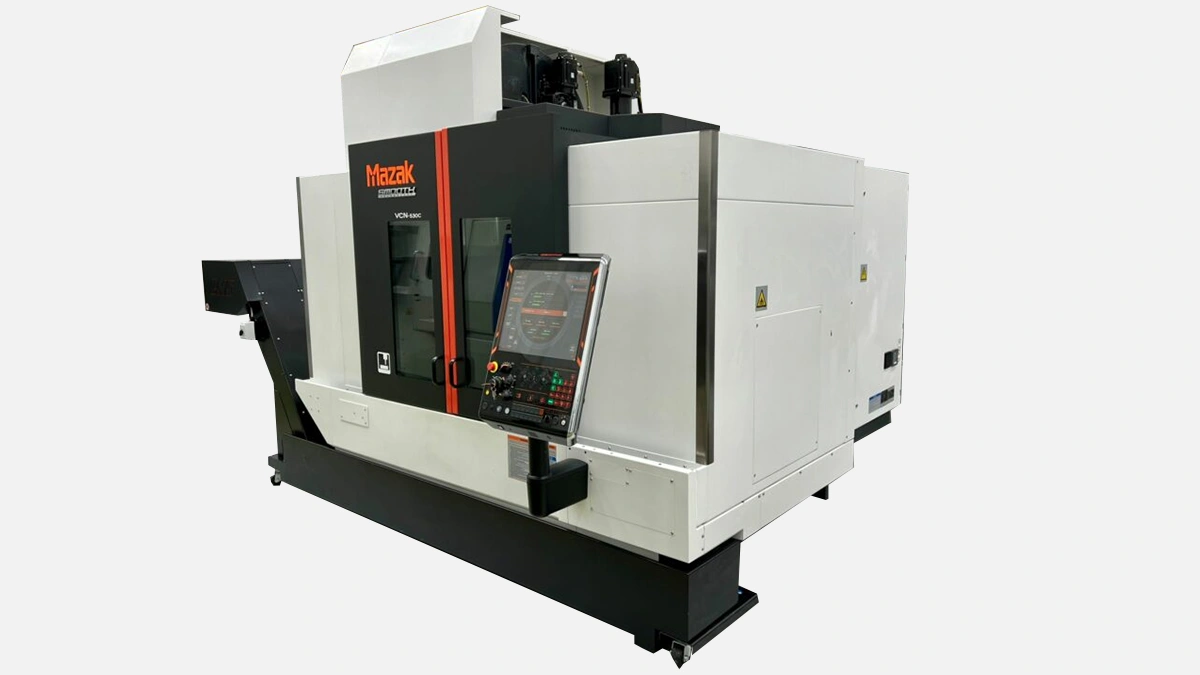
Travelling-column VMC, 1050×530×560 mm travels, 30 kW 12000 rpm spindle, SmoothG control, solid pick for UAE mid-size job shops.
Short look, big frame. Steel everywhere. The VTC-530C stands there and kind of dares you to throw something heavier than you planned. I walked around it, blinked twice, surprise, the column feels stiffer than my old MB-56. So yes, first vibe, confidence, then a sudden flood of questions, why did Mazak cram 1050 mm on X yet keep footprint humane, how does that affect chip flow, can the operator reach the back corner without a ladder, and so on. Pause, coffee.
Then a longer sentence barges in, because memory kicks up that Mazak has been on the market since 1919, turning out well over 200 machine models yearly, and this specific VTC line saw at least 3 generational refreshes, each time tweaking the spindle cartridge and adding more linear guide preload, so what we see now is not some first-try prototype, it is iteration over iteration, user complaints baked into metal.
Before we drown in trivia, here are the headline moves, in no particular order, just the way they jump into my head.
Take a breath. Those points are day-to-day reality in UAE job shops where batch sizes fluctuate, humidity sits low but ambient heat climbs to 45 °C, and nobody has time for a spindle warm-up that drags half an hour. The 530C hits operating temp quickly, partly thanks to Mazak’s spindle chiller loop, partly because the casting mass simply soaks heat and stays put.
Numbers alone feel sterile, yet we cannot skip them. I tossed the crucial ones into a table, then we will chew on what they mean in real life.
| Feature | Figure |
|---|---|
| X travel | 1050 mm |
| Y travel | 530 mm |
| Z travel | 560 mm |
| Table working area | 1300 × 550 mm |
| Max load | 800 kg |
| Spindle taper | CAT-40 / BT40 |
| Max spindle speed | 12000 rpm |
| Spindle power (cont/30 min) | 22 / 30 kW |
| Rapid traverse | 42 m/min |
| Tool magazine | 30 pockets (option 48) |
| Control | MAZATROL SmoothG |
Fine, table done. What jumps out, the column travel combo lets you drop a 1500 mm long extrusion, mill one half, index, finish the rest without un-clamp. That makes a difference when your customer shouts for one-piece batches at 2 AM. Meanwhile the 42 m/min rapids are not class-leading, but honestly anything over 30 already outruns typical cutter engagement exits, and higher speeds often shake taller parts, so I prefer this balanced compromise.
Switch mental channel. The Gulf climate is brutal on ball screws. Mazak’s internal oil-air lube keeps a micro-film even when ambient creeps past 40 °C. I have torn down a VTC-300 that logged 22 000 spindle hours, screws still within tolerance, that speaks louder than any glossy brochure. Power grid stability, another headache. The 530C’s regenerative drive pack tolerates ±10 % voltage swing, again real feedback from Sharjah where gensets share the load with DEWA at odd hours.
Coolant capacity sits at 270 L. Mazak offers an optional through-spindle chiller, but many UAE shops simply bolt an external chiller skid, fits well, hoses clear the rear service door. Chip conveyor is hinge type, clears 12 kg/min. I have seen it spit out 7075 curls non-stop for eight hours, no choke.
Time to pit the 530C against the crowd. I lined up three usual suspects, Okuma GENOS M560-V, Haas VF-4SS, and DMG MORI CMX 1100 V. Short bullets, then move on.
Mazak’s edge is the travelling column concept, table static relative to base, which means heavy parts do not ride an axis, inertia stays low, servo loops stay tight. Over a night shift that stability makes tool life more predictable, a cost line bean-counters actually notice.
Mazak labels anything with VTC when the column moves, but sizes vary. Quick rundown.
Interesting bit, many UAE owners pair a 300C with a 530C on the same floor, share tools, share fixture plates, shuffle workload daily. Maintenance crews like that, common spare inventory.
Imagine an order for 120 mild steel manifolds. Raw stock weighs 620 kg each. Forklift drops blank on the table, operator bolts custom risers, probes datum with Renishaw, cycle start. Rough mill with a Ø80 face mill, 3 mm depth, 80 % radial, coolant flood, chips fly. The column glides, no table slap, finish pass later with a Ø20 end mill at 10 000 rpm, chatter low, surface Ra lands under 1.6 µm. That is not marketing talk, we logged those numbers last week in Ajman.
Switch to aluminum bracket batch, five pieces nested, single clamp, high feed Ø12 cutter at 15 m/min feed, spindle stays at 12000 rpm because that is top end, obviously the machine is not a speed mill, yet torque at mid-range keeps the tool engaged, and the through tool coolant blasts chips clear, avoiding recut even when pockets get deep.
SmoothG, love it or hate it, but it does shorten set-up. Conversational screens let junior operators punch pockets without CAM. For seasoned programmers the real pearl is Dynamic Fixture Offset, a one-click re-zero after a pallet swap. Toss in EIA mode, standard G-code, you are not locked. Ethernet, MTConnect, all expected, nothing exotic.
Floor space about 3.4 × 2.9 m, crane hook clearance 3.6 m. Weight 9000 kg, so a decent six-inch slab does fine. Three phase 400 V at 50 Hz, line draw peaks 60 A, normal run 35 A. Compressed air 0.5 MPa constant, dryer mandatory in coastal Emirates to avoid solenoid rust.
Quick anecdote, a shop in Ras Al Khaimah lost the spindle drive after a lightning surge, Mazak Gulf team swapped it in 12 hours, machine cutting again before the weekend. Spare flanged bearings are stocked in Dubai free zone, not a sales pitch, just fact.
No machine solves every problem, contradicting myself, the 530C gets close for the mid-range envelope. Travelling column keeps dynamics honest, table load impressive, spindle power balanced. Shops feeding aerospace seat tracks, oilfield flanges, even custom motorcycle frames, they gravitate to this model because it covers all without drama.
In other words, if you already juggle 3–4 verticals and want to retire the loudest one, 530C is the quiet upgrade that simply starts earning chips the moment riggers bolt it down.
That is it, brain dump complete, chips brushed off, coffee empty. Next cycle.