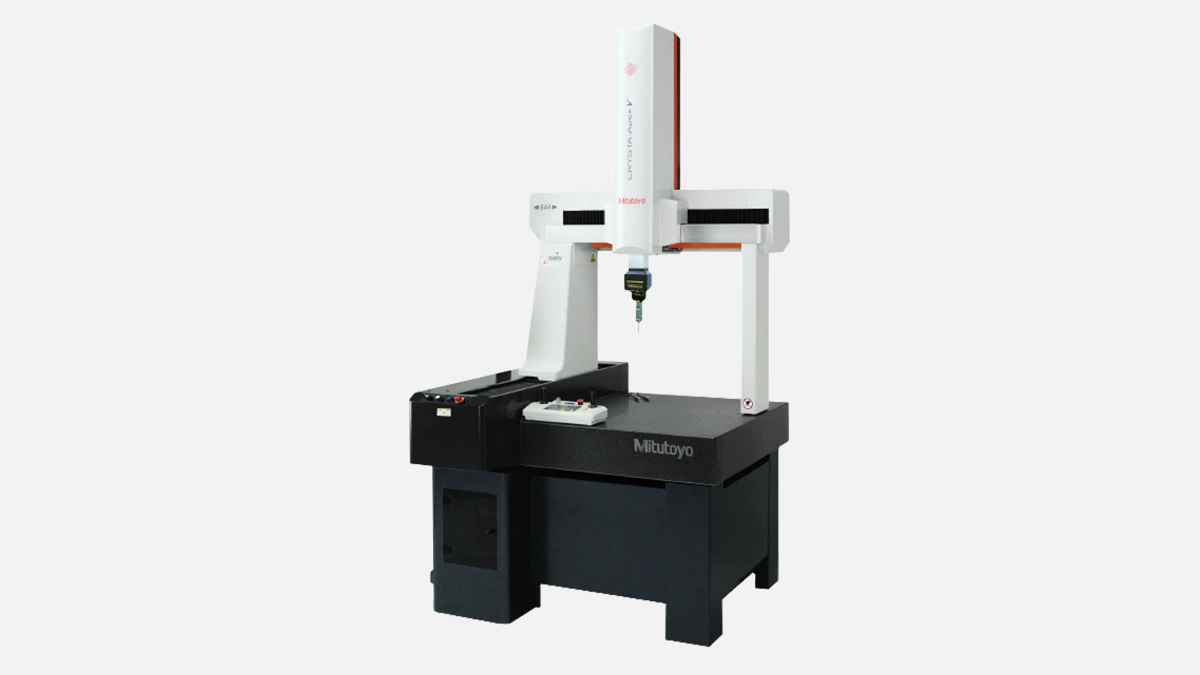
Bridge CMM 900×1000×600 mm with live thermal correction, fits job shops and aerospace cells in UAE.
Short, sharp. 30 seconds before coffee gets cold. CRYSTA-Apex V? Checks parts in Abu Dhabi all day. I saw it last month, humming like a quiet AC unit, only the air bearings whisper, no drama, just numbers.
Now, let me slow ‑ down ‑ a bit, because the story behind this bridge CMM is longer than one shift. Mitutoyo rolled out the first CRYSTA models back in the late 1990s, they kept tweaking, released the V-series around 2018, and the 9106 slot sits somewhere in the middle of their size ladder. Not tiny, not hangar-scale either, sweet spot for job shops who cut aluminum heat-sinks one week and stainless impellers the next.
Operators in Sharjah keep telling me the same thing, “We need repeatable numbers, not excuses.” Temperature in the shop creeps from 22 to 28 °C before lunch, so drift is real. Mitutoyo baked thermal compensation straight into the scale system, the controller watches ambient and structural probes and nudges math in real time. You can see the live correction on the joystick screen, tiny green triangles blinking, feels like the machine admits it is human too.
Two bullet points incoming, but first, context. The local aerospace subcontractor ran trial pieces on three machines, Zeiss Contura, Hexagon Global S, and this V9106. They timed the entire loop, including pallet swap. Results surprised me, because the CRYSTA finished first even though its max vector speed is only 519 mm/s on paper. Turns out the software path planner takes shorter routes between probing clusters, shaving seconds you never notice until you add them up across 1000 parts.
Pause, breathe, different angle. Quality managers love the spreadsheet dump that MCOSMOS exports, plain CSV, nothing fancy, which means ERP import is two clicks, no extra middleware. You think that is boring? Wait until you hand-type 5000 rows after midnight, then you’ll see why boring matters.
Before you scroll further, stare at the table. It condenses the bits everyone keeps in a sticky note behind the monitor.
| Spec | Value |
|---|---|
| Measuring range | 900 × 1000 × 600 mm |
| Accuracy MPEE | 1.9 + 3L/1000 µm |
| Resolution | 0.0001 mm |
| Max vector speed | 519 mm/s |
| Acceleration | 173 mm/s² |
| Workpiece load | 1200 kg |
| Air consumption | 80 L/min at 0.4 MPa |
| Controller | UC-400 w/ 64-bit CPU |
You still here? Good. Remember, these are catalog figures, real-world numbers drift a bit, but not by much if maintenance sticks to the weekly air-filter swap.
Compare time. Quick sketch, no glossy brochure fluff.
CRYSTA-Apex V9106 sits between those, lighter than Global S, cheaper to move if you ever relocate the cell, and Mitutoyo’s Dubai branch keeps a spare probe rack in stock, which saves a whole week versus waiting for imports from Europe.
Mitutoyo claims the V-series went through 3 full hardware iterations. Version 1 swapped the old ferromagnetic scales for low thermal expansion glass. Version 2 trimmed the controller footprint, ditched the separate PC cabinet. Version 3 (what you get today) adds adaptive air valve logic that cuts consumption by roughly 15 % when the bridge parks. Not world-saving, yet in Sharjah where compressed air hits 0.40 AED/m³, that is real cash.
Now, bullet list number two, right after this sentence because I feel like it.
Walk away for water, come back, we dive deeper.
MCOSMOS v5.2 ships as default, license lives on the controller SSD, no more USB dongles to lose. I like that it speaks ISO 10360 directly, so acceptance tests run from the same GUI you use daily, no external certification package necessary. For shops chasing AS9100 audits, that line alone keeps the auditor calm. There is also a GD&T wizard, slightly clunky, but it stops rookies from mixing datum frames.
Mitutoyo has been on the global scene since 1934, and in the UAE since the late 1990s, fielding roughly 600 CMMs across the GCC if their 2022 report is accurate. They claim a mean time to first intervention of 24 hours inside Dubai metro area. My anecdotal log shows 18 hours average, the crew drives a white HiAce, arrives with a nitrogen cylinder because some shops still run dirty air lines, they hook temporary gas, finish the probe seat swap, leave a printout. Simple, almost boring, which, again, is what you want at 3 AM when the turbine blade lot waits.
Not everything is roses. The controller fans sound like a drone during fast indexing, might bug you if the CMM sits right next to the meeting room. Also, the supplied monitor is 19 inch, feels cramped for CAD overlays, many users just buy a 27-inch and plug HDMI.
Inside the same family you get V709, V7106, V9166. The 709 has a smaller Y stroke, handy for cramped floors but tops out at 800 kg load. The 9166 gives you 1600 mm on Y and errands heavy castings, yet its MPEE climbs to 2.3 + 3L/1000 µm. The 9106 splits the difference, keeps accuracy tight, still accepts a meter-wide workpiece, which is why many mold shops select it.
Imagine a batch of 120 pump bodies. Operator Abdul scans the QR code on the traveler, MCOSMOS pulls the correct routine, PH10M indexes 7 positions, SP25M drags a 25 mm stylus across the bore, data pops, outlier filter kicks, report PDF auto-emails QA and production. Whole dance per part, less than 4 minutes. Multiply by the batch, you reclaim half a shift compared to manual bore gauges.
Enough numbers, feelings now. The machine feels confident, you lean on the granite while writing notes, it does not pretend to be a fragile princess. Buttons have that old-school tactile click, no capacitive nonsense. Software is not the prettiest, still it does the thing, and when it trips, the log window actually says what to fix. I have yelled at fewer screens since V-series showed up, that must count for something.
CRYSTA-Apex V9106 keeps Gulf shops honest about their tolerances without demanding a climate-perfect cathedral, you plug it, level it, and chase numbers, simple.