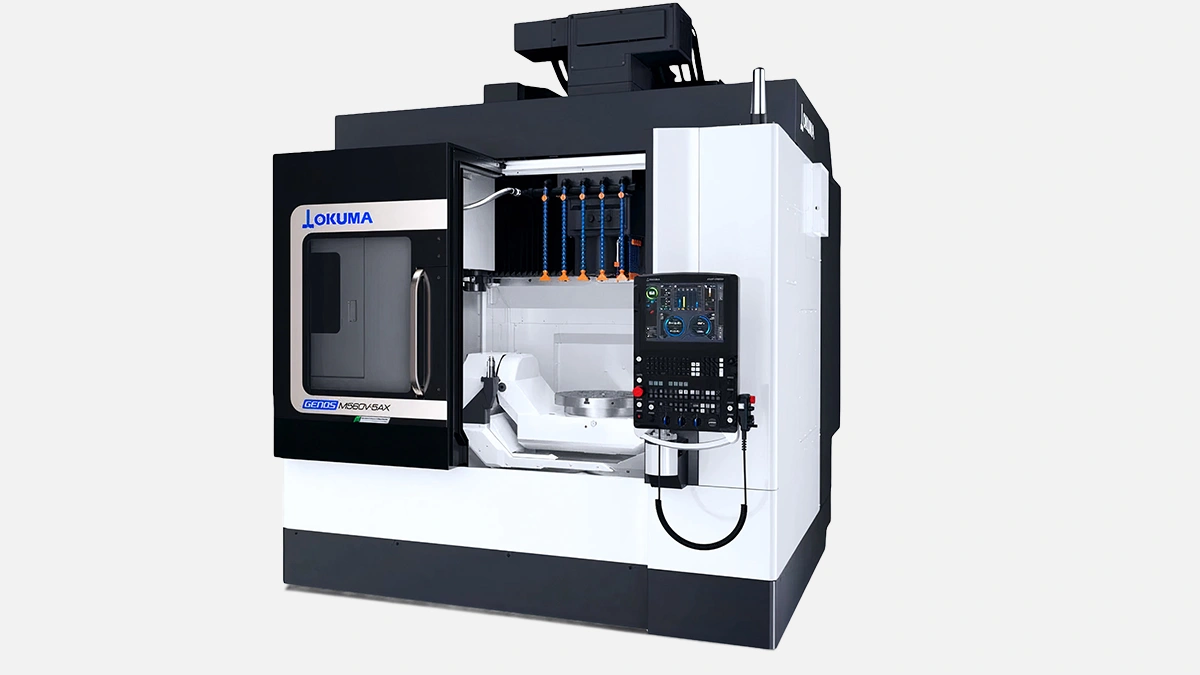
GENOS M560-V: 1050 × 560 mm travel, 15000 rpm spindle, 900 kg table load in a compact UAE-friendly footprint.
Short breath. Look left, the column towers. Steel, paint, no drama. Yet the moment the 15000 rpm spindle kicks, the shop floor vibrates in that low bass that tells any operator, hey, things are about to get real.
Okuma has been making machine tools since 1898, around forty models roll out of the Nagoya plant every month, that is not marketing fluff, that is plain shipping data quoted by the company newsletter in 2023. The GENOS family itself counts three main sizes, the M460, our M560, and the slightly larger M660. The 560 sits right in the sweet spot, large enough for an oil-field manifold plate, still compact for a Dubai subcontractor squeezed between sheet-metal racks.
The UAE scene is hungry, really hungry, for vertical centers that chew through stainless without drama. Operators I met in Sharjah complain about thermal drift on budget machines, especially during July when the ambient stays above 38 °C even with AC. The M560 fights that drift by circulating spindle oil at a constant 26 °C and parking the ballscrews in a double-supported arrangement. No fancy words, just physics.
Before diving into the chatter, park a quick table on the page because everyone keeps asking the same thing, how big, how fast, how strong.
| Axis | Travel | Rapid rate |
|---|---|---|
| X | 1050 mm | 40 m/min |
| Y | 560 mm | 40 m/min |
| Z | 460 mm | 32 m/min |
That is the core, but do not ignore the 900 kg payload. Many job shops in Abu Dhabi load steel fixtures plus raw stock that together cross the half-ton line. Cheaper tables sag, the M560 table stays flat within ±5 µm across the full stroke according to a Renishaw ball-bar plot shared on practicalmachinist.com. Yes, that was a user post, not corporate literature.
The previous paragraph throws numbers, time to breathe.
That bulleted trio often pops up in RFQs. Buyers care about holes, chips, post-processing. Still, one more line. The spindle warms to full spec in eight minutes from cold start, measured with a K-type thermocouple taped at the nose.
Let us line the kid against other street names. Haas VF-4? Similar envelope, but you need optional 15k spindle, plus the Okuma torque curve sits higher below 2000 rpm, good for roughing. Mazak VCN-530C? Robust, agreed, yet the standard tool magazine holds 30 while Okuma gives 32 as baseline. DMG Mori CMX 1100V carries a classy design, though its table load tops at 1000 kg only with the heavy-duty package. In day-to-day steel, the delta feels minor, yet in aluminium where feed jumps to 10 m/min, the M560 keeps step thanks to a 1.4 G acceleration spec, numbers Haas publishes only as optional high-speed kit.
Notice something, I did not crown a winner. There is none. These comparisons just show where the M560 sits, upper middle, reliable, no drama.
The smaller M460 sports 762×460 mm travel, fine for medical parts. The M660 goes to 1500×660 mm but adds length, weight, cost. Shops chasing valve bodies pick the 660, most general subcontractors land on the 560. Interesting side note, all three share identical spindle cartridges, meaning your spare parts shelf stays lighter.
I walked into an Al Quoz job shop last May, two M560s running back-to-back on hydraulic manifold work. Operator Ahmed (he swears by open-end wrenches over torque wrenches, long story) showed thermal deviation from dawn to dusk staying within ±7 µm on a 200 mm test bar. Ambient peaked at 42 °C that day, AC struggled. Nothing tripped. That anecdote weighs more than glossy brochures.
Another case, Sharjah college prototyping center, same model, but with the optional 48-tool magazine. They switched between aluminium impellers and mild-steel clamps all week, relying on the tool-life management built into OSP. You set upper load at 80 %, control parks the cutter once the spindle power curve drifts, calls the sister tool automatically. The supervisor told me downtime dropped by 17 % during their first quarter.
Some CNC veterans grumble about Okuma’s macro syntax, it is not Fanuc. You write VC = VX(1) instead of #100 = #1. Minor annoyance. Yet the integrated collision avoidance, yes the feature everyone first disables, actually works if you feed the real tool gauge length. I saw it save a freshly ground Ø16 carbide end mill when the fixture sat 2 mm higher than the CAD zero. Loud beep, spindle halt, nothing snapped.
Before you decide, note the add-on lineup, a quick bullet swirl is easier than paragraphs.
* 4th axis rotary, Ø200 mm, plugs directly into the M560 M-codes, wiring preinstalled at factory.
* Probing kit by Renishaw, triggered automatically at tool change, offsets update in under 18 s.
* Chip blaster upgrade to 110 bar for aerospace aluminium pocket work.
Each option stacks cost, but they plug in without field hacking, a relief for maintenance crews.
Oil equipment repair in Ras Al Khaimah, aluminium signage in Ajman, aerospace bracket machining near Abu Dhabi airport. Three totally different workloads, same chassis. The common reason they sign the PO? Predictable uptime. Okuma publishes 8760 h MTBF on the spindle bearing set, and field data from their Singapore tech hub shows 0.3 % unscheduled spindle failures in Asia-Pacific during 2022. Numbers are dry, still comforting for plant managers betting on tight delivery penalties.
No fairy tales. The GENOS M560-V is a workhorse, nothing more, but that is exactly why it keeps popping up in RFQs across the Gulf. Reliable axes, healthy spindle, control that refuses to crash. If your part mix fits inside 1050 × 560 × 460 mm, you can buy once and forget the word retrofit for a decade.
At the end, four bullets, plain and simple.
– Rigid double-column casting keeps tolerances when the warehouse AC dies in August.
– High torque curve at low rpm, great for tough alloy roughing without chatter.
– Integrated thermal compensation means less manual tweaking, more unmanned hours.
– OSP control bundles probing, tool life, collision avoid, no third party licenses.
That is it, curtain down.