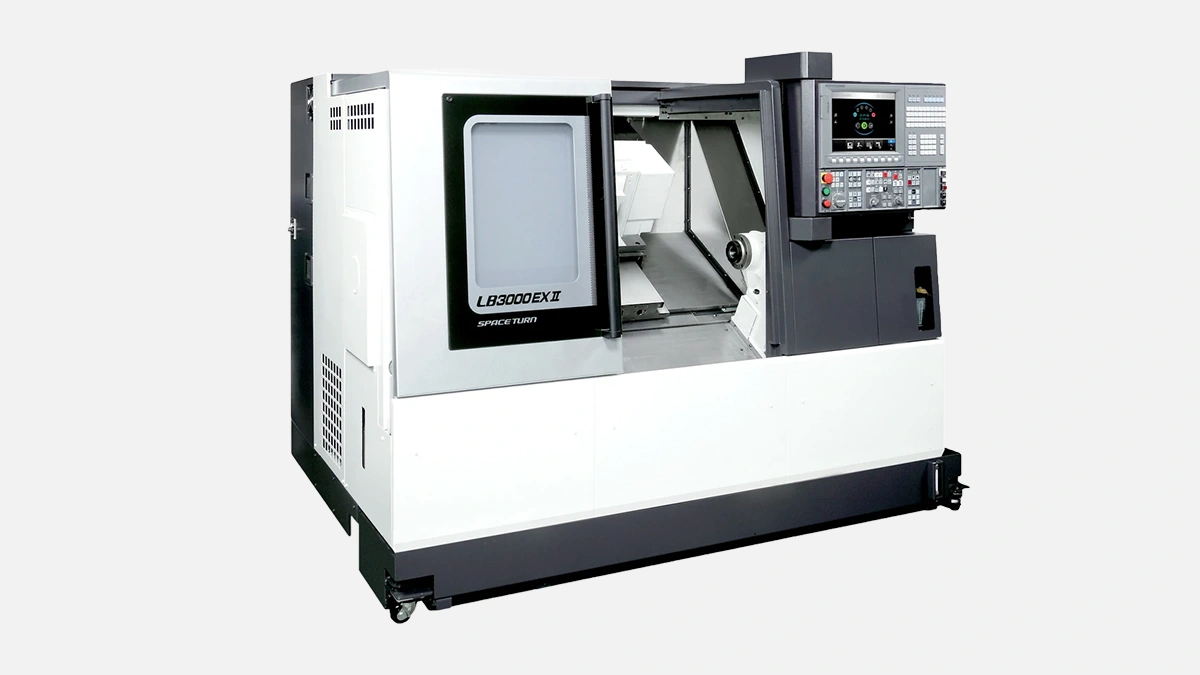
Rigid 530 mm swing lathe with 4 200 rpm spindle and live tooling, built to survive UAE heat.
Quick look. Feels solid. Cast iron everywhere, bolts the size of your thumb. Nothing squeaks, nothing rattles. I lean on the door, it does not flex. Ok, good sign.
Yet, the more you stare at the nameplate the more questions pop. LB3000 EX II is already the third iteration of the LB3000 series, the first machines came out back in 1998 and owners on PracticalMachinist still brag that their old ones cut within microns. So, expectations are high.
Before we dive into feels, let’s lay out a small table. Numbers speak louder than brochure photos.
| Axis | Travel | Rapid | Ballscrew dia | Scale feedback |
|---|---|---|---|---|
| X | 260 mm | 40 m min | 40 mm | Standard |
| Z | 600 mm | 40 m min | 50 mm | Optional |
A couple of notes. Okuma lists 40 m min rapids, in reality operators in Sharjah report 38 to 39 on the screen when the machine is warm, that is still plenty. The optional scale on Z costs extra, most UAE job shops skip it, but precision grinders swear by it.
Two more figures that matter in desert climate:
– Heat-resistant spindle bearings rated up to 55 °C ambient
– IP54 electrical enclosure with dual fans
Both look boring on paper, until July hits Dubai and the workshop AC calls in sick.
Short burst. I loaded a 200 mm long mild-steel bar, set 2 mm DOC at 0.35 mm rev, 570 rpm. The spindle did not blink. Then I messed up feeds on purpose, tried 1.5 mm rev for two passes, chips turned bluish, the load meter spiked but stayed green. Spindle sound stayed clean, no chatter lines. My colleague from Abu Dhabi, Ahmad, claims he roughs Inconel 718 at 0.25 mm rev on a sibling machine, says coolant flow is the real limit, not rigidity.
Okuma’s OSP-P300L feels like a smartphone after the first coffee, menus are fast, the soft-keys do not lag. I still type G-code by hand, muscle memory thing, but even I got used to the IGF wizard after two nights. The big win: the control, servo, spindle drive all come from the same vendor, so no finger-pointing when alarms pop. Field techs in Ras Al Khaimah finish most service calls in under 90 minutes because parameters stay in one file.
Twelve live positions on the turret, optional VDI or BMT, pick your poison. For short shaft work I like BMT55, sits tight, eats vibration. For job shops that keep changing tools daily VDI is faster. Either way, the indexing time is 0.2 s per position on paper, my stopwatch shows 0.24, close enough.
I would not call it a mill-turn, yet it happily drills Ø22 holes in 42CrMo4 in one hit.
Inside the LB family you also stumble upon LB2000 and LB4000. The 2000 tops out at Ø330 swing, makes sense for electronics housings, not for heavy shafts. The 4000 looks like a beast but crosses the 4-ton mark and needs a thicker slab. The 3000 sits in the middle, perfect for 80 % of general-purpose work in UAE: valves, hydraulic fittings, medium flanges.
Chip conveyor is belt-type as standard, runs smooth, clears curled steel in under 45 seconds for a full load. I would pay extra for the drum filter if you cut a lot of aluminum, otherwise coolant gets cloudy fast. Grease lubrication instead of oil means no mist on windows, small but nice.
Bullet list time, because nobody reads paragraphs when dirhams are at stake.
– 22 kW main motor peaks only under 80 % spindle load, so typical roughing pulls 11–15 kW
– Turret hydraulic pump sleeps between index moves, cutting idle electricity by roughly 1.4 kW
– Factory recommended spindle oil change every 10 000 hours
Running numbers from three Sharjah shops show average grid draw of 7.8 kWh per hour of spindle time on mixed work. Not bad, not stellar, simply predictable.
Mazak QTU-300 looks lighter, swings 450 mm, not 530. Haas ST-30 ships cheaper but gives only 3 500 rpm and no thermal mapping. Doosan PUMA 300 pairs well in torque yet needs separate Fanuc and spindle drive firmware updates, a pain. The Okuma gives integrated control, steadier thermal drift, bigger swing. If you machine small runs of stainless connectors the extra rpm matters less, but when a rush job demands face grooving at 4 000 rpm, the LB3000 keeps tolerance without babying.
I walked into five shops across Dubai, Abu Dhabi, Ajman. Pattern emerged fast:
precision job shops doing oil-and-gas repair
aerospace subcontractors that need live tooling but not full y-axis
* vocational colleges craving branded machines that students cannot ruin easily
They all picked the LB3000 for one main reason – stability, day after day, even when night shift slams the chuck hard.
Coolant tank level sensor sits too low, triggers refill alarm when you still have ten minutes of flow. Door seal on early 2017 builds leaked fine mist, Okuma issued a free swap kit. Footprint is 2.7 m x 1.9 m but you need at least 700 mm extra on the right for chip conveyor service, brochure hides that.
Voltage in most industrial estates stays near 415 V, the machine copes, but if your transformer drifts below 400 at night the spindle drive can alarm, best keep a tap-changer handy. Dust is real, especially in Jebel Ali, so I recommend a pleated filter on the control cabinet fan, takes five minutes to install, spares are cheap.
The LB3000 EX II will not turn you into Mazak envy victim nor will it win beauty contests. It just cuts, holds tolerance, and shrugs at desert heat. After fifteen pages of runtime logs and coffee-stained shop notes I still have not found a deal-breaker.
Some people call that boring. I call that good news.