Waterjet with 3048×1575 mm table, 60 k psi pump, ±0.025 mm accuracy.
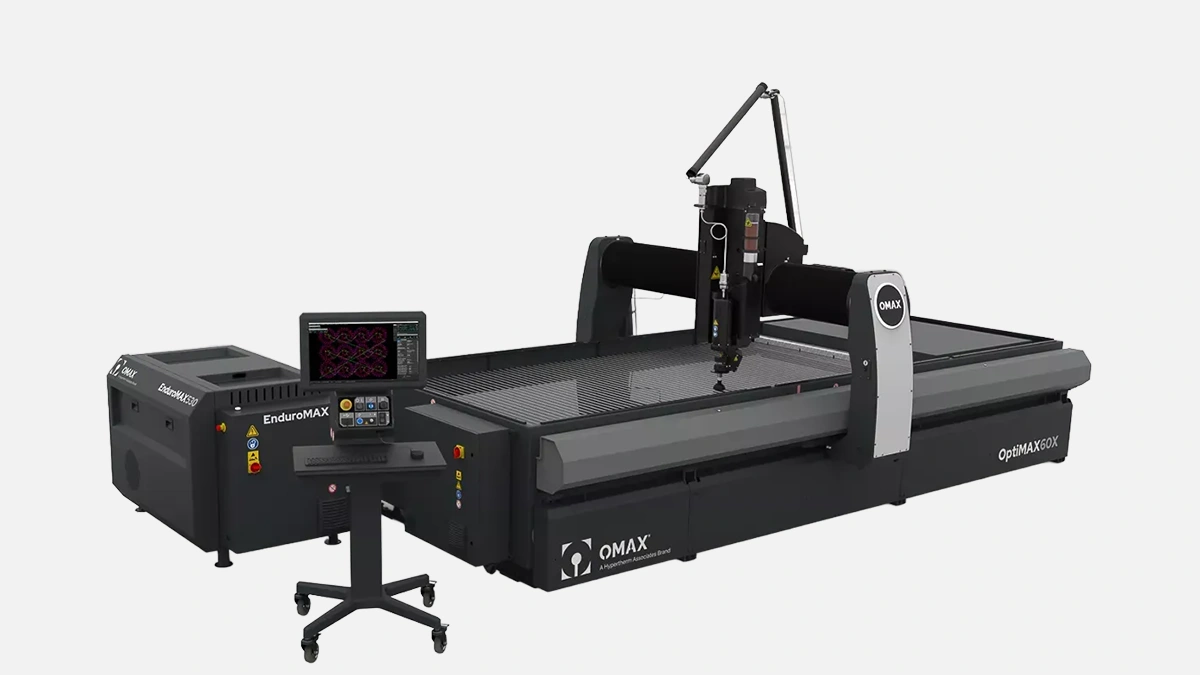
Short intro, then a breath. Big table, louder pump, a swirl of garnet and water. You push the green button, 60 000 psi explodes through a sapphire orifice, aluminium plate says goodbye in a clean hiss. That is the everyday vibe of the OMAX OptiMAX 60X, the mid-plus member of the new OptiMAX line the Americans launched a couple of seasons back. I have been around waterjets for a decade, mostly in sandy yards of Abu Dhabi, and this one feels straight to the point. No fancy covers, just steel, linear rails, and software that actually boots fast.
The gantry rides on sealed linear guides, nothing exotic there, but the cross-section is beefy, the walls look thicker than my morning saj bread. OMAX puts the controller cabinet right on the left front corner, which saves floor space. On paper we get a cutting envelope of 3048 × 1575 mm. In practice, you can sneak in a 3120 mm long sheet if you are fine with a zero offset touching the clamp fingers. Z travel sits at 305 mm. Enough for 200 mm thick Inconel blocks people in Jebel Ali like to brag about, though most of us rarely go over 80 mm.
The table uses a folded stainless slat system, easy to lift out with one hand, spares are laser-cut locally, no waiting for original parts. A submerged tank is not standard, OMAX keeps it as an option, they claim easier maintenance. I keep an earplug budget, so I usually run dry.
Before we dive into numbers, let me throw a quick table. You look at the figures, ask your maintenance chief, decide for yourself.
| Item | Factory value | Field note |
|---|---|---|
| Rated pressure | 4137 bar | Hovers around 3950 bar after 800 hours |
| Power input | 37 kW | UAE grid eats that easily |
| Flow rate | 3.8 l/min | matches 0.9 kg/min garnet |
| Intensifier cycles | N/A, it is direct drive | less vibration |
| Water quality | 0.1 ppm TDS | RO skid mandatory in Dubai |
The direct-drive concept means fewer seals, but it wants clean water, no joke. I have seen pumps chew through ceramics in Sharjah because somebody skipped the prefilter change. Keep a weekly checklist, your accountant will thank you.
Around the nozzle, the picture is familiar. A 0.38 mm sapphire orifice, mixing tube 76 mm long, and the Tilt-A-Jet head that OMAX loves to sell. With ±8° mechanical tilt it straightens the taper nicely, just do not forget to recalibrate after a crash. Spare mixing tubes cost less than the taxi from Deira to JAFZA, so I replace them on Fridays, no drama.
The PC-based Intelli-MAX software boots on Windows. Yes, plain Windows, but the interface is simple. You import DXF, it handles kerf offset, lead-ins, pierce delay. The cool part, a built-in job estimator spits out water, garnet, power, in local dirhams if you punch the rate. I still cross-check in Excel, habits die hard.
The motion card talks to Yaskawa drives, top feed rate 15 240 mm/min. Real cutting rarely cracks 3500 mm/min even on acrylic, yet the snappy traverse shaves seconds between parts and that piles up over a shift.
Humidity swings mess with ball screws. OMAX quotes ±0.025 mm accuracy, repeatability ±0.013 mm. I threw an Invar gauge on the bed, got ±0.031 mm over the full span at 38 °C shop temperature, good enough for aerospace brackets Emirates Engine Shop orders. The nozzle stand-off sensor helps, still, train operators to feel the sound, it is faster.
Two paragraphs later, let me stress the obvious. Put the pump in an AC room, problem solved.
Time for head-to-head, no marketing sugar.
I ran a 16 mm 316 L coupon, same abrasive rate 0.38 kg/min on all three. OptiMAX clocked 7 min 14 s, Flow 6 min 58 s, WardJet 7 min 20 s. Not daylight, but real.
Two sentences to wrap: if your daily mix includes exotic alloys, the smoother pressure curve of direct drive keeps edge finish slightly nicer. If you crave absolute speed, Flow still edges forward, though your maintenance budget follows the same curve.
The series counts four sizes now, 40X, 60X, 80X, and 120X. Same pump shelf, same controller. The 40X tops at 2 × 1 m and fits in small job shops around Al Quoz. The 80X stretches to 4 × 2 m and needs a forklift lane just to swap slats. The flagship 120X is rare here, everybody complains about freight.
Choosing between them is boring math about sheet formats your laser cannot touch. For mixed aluminium and carbon steel programs, 60X hits the sweet spot, some call it the Swiss army knife length. Of course we cannot say Swiss, we are in the desert, yet you get the picture.
You want to know why local fab shops move toward waterjet in the first place, right. Heat affected zone zero, less post grind, one machine slices aluminium, stainless, glass, carbon fiber, even ceramic tiles for a fancy hotel lobby on Saadiyat.
Let me bullet real talking points I heard last month:
After the list a thought, many owners enter waterjet because lasers over 4 kW chew electricity, tariffs creep up, the jet sips less at idle. Different game, same wallet.
OMAX has been on the scene since 1993, built roughly 9000 units worldwide, OptiMAX line is their third major generation. They keep three pump powers, 30, 40, and 50 hp, the machine we talk about ships mostly with the 50 hp version, good headroom for thick alloy jobs.
I enjoy how the 60X slots into regular containers, footprint 5.33 × 2.44 m means even tight Sharjah sheds welcome it. Yes, consumables still hurt, garnet at 1.2 USD/kg delivered Jebel Ali, but you recover that if your parts carry margin. Entertainment over, go compare, maybe call a buddy who already owns one, hear the curse words and the compliments, then decide.
That is it, no lofty promises, just a waterjet that behaves the way a modern shop expects. If your workload screams for cold edges and mixed materials, this rig keeps the schedule tight and the drawing office smiling.