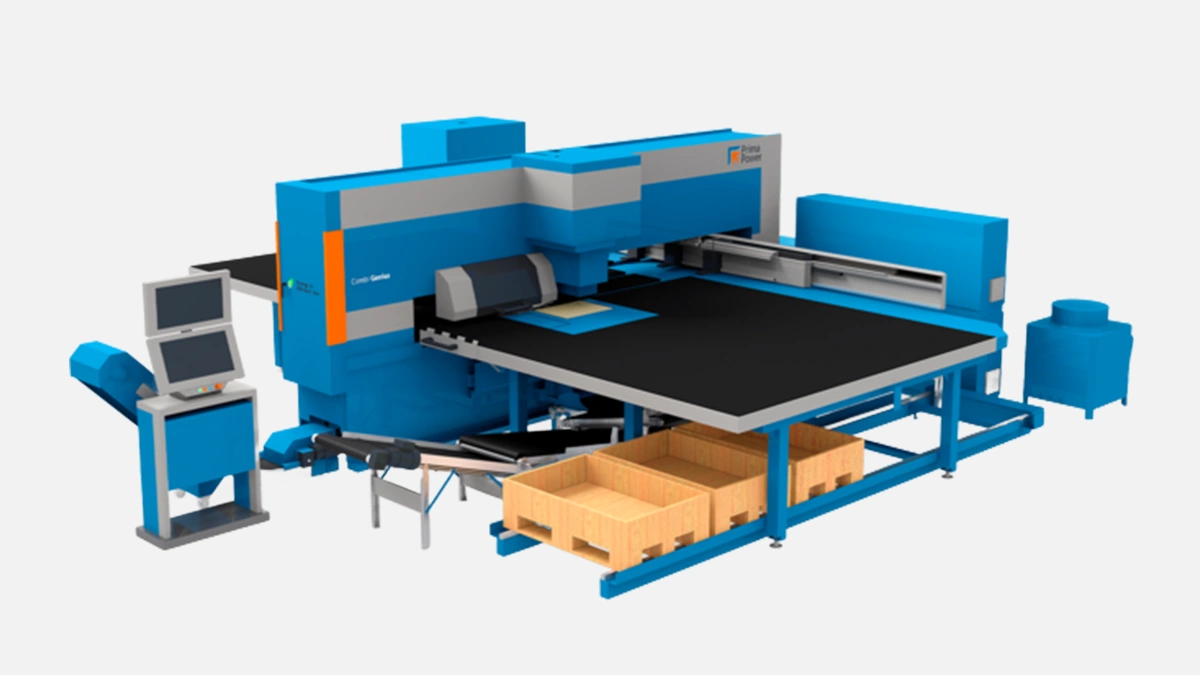
Servo-electric turret punch 300 kN, 1000 hits/min, 2500×1250 mm sheet.
Right, let me hit you with it straight away. Prima Power has been in the punching game since the early 1980s, shipped north of 12 000 turret presses by different names, still counting. Punch Genius is their current all-electric workhorse, fifth iteration if you trace it back to the legendary Finn-Power C series.
Small intro, then table. The machine uses a rigid O-frame, servo motors drive the ram, there is no hydraulic pack humming in the corner, nice if your plant is already loaded with compressors. The drive behaves fast yet repeatable so thin aluminum sheets do not warp.
| Item | Detail |
|---|---|
| Frame style | Welded O-frame, normalized |
| Ram drive | AC servo direct crank |
| Tooling | Thick-turret 32 stations |
| Clamps | 2 programmable, auto relocate |
| Brush table | Full coverage, low scratch |
Two sentences to walk away from the table. Operators I talked to in Sharjah liked the low noise when running night shift, you can literally hold a phone call three meters away. That is handy in mixed production halls.
The catalog shouts 1000 hits per minute on a 1 mm pitch, real production with tool changes sits around 350–400 hits, still faster than older hydraulic presses that stop to cool oil. The axis combo of X 80 m/min plus Y 60 m/min lets the head reposition as quick as your loader can feed.
Back to prose. UAE shops often run stainless kitchen panels one shift, perforated AC grilles the next, so the mix of thin sheet and up to 6 mm galvanized is common, the Genius punches both without parameter gymnastics.
I know electricity in Abu Dhabi is cheaper than in Europe yet no one likes waste. Prima quotes 8 kW average draw, peak below 14 kW on thick material. For comparison an entry level hydraulic press of same force can pull 25 kW when the pump throttles. Multiply that by a 10-hour shift, five days, you see why users notice the meter.
Energy chapter done.
Prima sticks with thick-turret, every UAE distributor stocks punches from Wilson, Mate, the local guys even grind them for peanuts. The turret carries 32 stations, 3 of them auto-index 360°. That alone handles louver tools, corner notches, logos without custom jig plates.
Surprising bit, the ram can vary stroke from 0.1 to 16 mm on the fly. Nibble shallow, then hit full penetration, same program line. Older mechanical presses cannot.
Positional repeatability is ±0.03 mm on a short run ticket, call it ±0.05 mm when the sheet stretches over two reposition moves. Good enough for telecom cabinets that need M4 extruded holes lining up with PEM nuts inserted by another cell.
No exotic granite bases, just proper ballscrews and laser compensation loaded into CNC.
The machine ships with the Prima NC Express e3, Windows 10 PC front end, touch or mouse. I am not a fan of Windows on shop floor yet at least the interface is familiar. Operators create nests, set clamp zones, tweak ram speed per tool, then send to the Siemens-based numerical core.
Genius can be bought stand-alone or paired with Compact Express loader. Many UAE buyers skip automation first year, then bolt it later when orders grow. Holes for anchor bolts are pre-drilled in the base casting, alignment pins already in place, so retro-fit takes one weekend.
Time to throw it against two names you surely know.
| Spec | Punch Genius | Trumpf TruPunch 3000 | Amada EM 2510 |
|---|---|---|---|
| Punch force | 300 kN | 200 kN | 300 kN |
| Hit rate 1 mm | 1000/min | 900/min | 600/min |
| Tool stations | 32 | 21 | 45 |
| Average power | 8 kW | 12 kW | 9 kW |
| Sheet without reposition | 2500×1250 | 2500×1250 | 2500×1270 |
Couple of follow up notes. Trumpf leads on adaptive forming, but you pay extra for every wheel tool. Amada wins station count, yet its dual servo head adds weight so axis speed drops, small parts tilt more often. Genius keeps a balanced spec sheet, plus poised price tag that mid sized Gulf shops digest quicker.
Punch Genius comes in three bed lengths, PG 1225, PG 1530, PG 1530 Plus. The last one stretches X to 3000 mm without reposition, aimed at HVAC ducts. Mechanics same, software same, only bed and clamp count grow from two to three.
I visited a plant in Ras Al Khaimah, they run two years already. Operator Ali said they changed one ballscrew cover, cost them 400 AED, that is it. Lubrication is centralized, drip lines every 40 seconds, the tank lasts a month. He joked the only thing he cleans daily is the brush table from aluminum dust.
Another visit in Jebel Ali Free Zone showed a Genius integrated with an LSR fiber laser for hybrid punching plus cut, but that is a custom project. Point is, control handshake is open, not locked behind license keys.
Conversely if your throughput is exclusively thick plate beyond 8 mm, go get a plasma, no sense abusing the ram.
Daily checklist fits on a sticker. Visual turret inspection, drain scrap box, wipe clamp jaws. Weekly grease slider block, flush coolant channel around the servo fin pack. Yearly alignment check with ballbar, dealer usually bundles it in warranty. No hydraulic oil change because, well, no hydraulics.
You can dig through Eng-Tips forum, user SteelArabia wrote that the servo stroke control let them reduce micro burr on 316L to under 15 micron, they skipped deburr wheel on thin panels. Another poster MansoorAl-Dhafra measured power draw using an ABB logger, confirmed the 8 kW spec within 10 percent.
Punch Genius is not trying to be a laser cutter, it is unapologetically a punching center. In the cluttered mid-market segment that honesty is refreshing. For UAE buyers the sweet spot seems to be quick lead time, reduced electrical load, tool compatibility with stock already on shelf.
The press arrived, it ran, it keeps running, pretty much that simple.
End of story. If your workload is light gauge to medium, if hole count per sheet is high, Genius carries its weight.