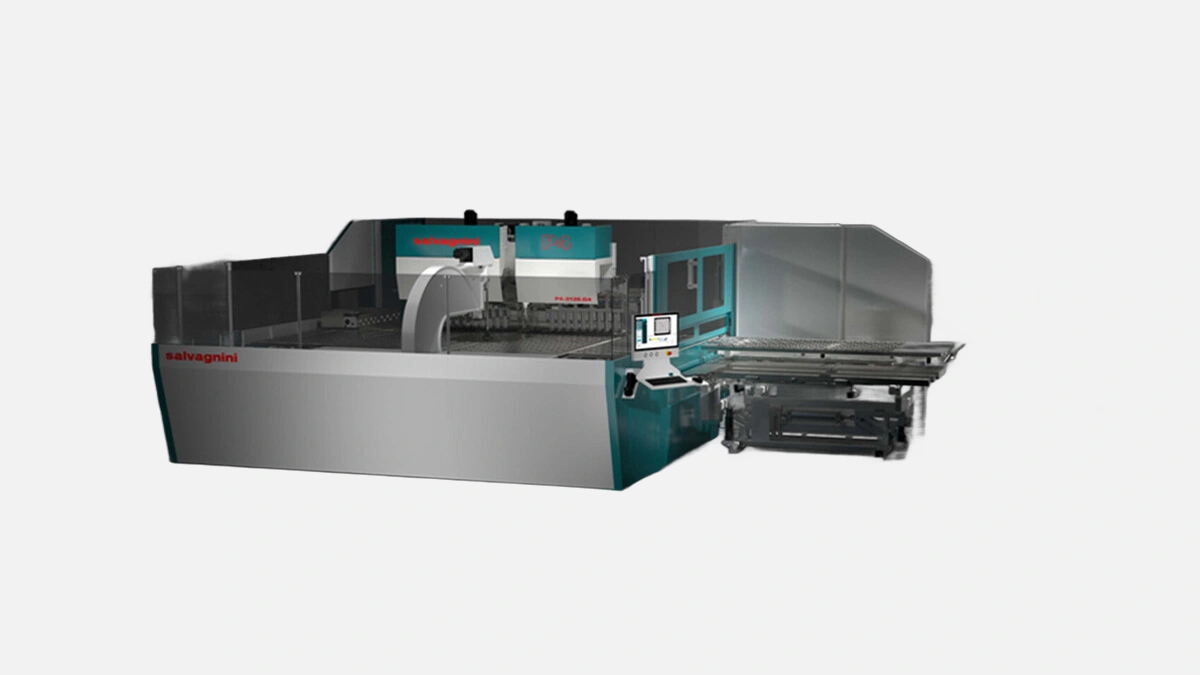
P4 bends 2180 mm panels up to 3.2 mm at 30 bends / min, auto tool change, fit for UAE enclosure shops
Short intro, really short. This thing bends sheet metal. Fine, you guessed.
Now a longer breath, because the context matters, Salvagnini has been around since 1963, ships roughly 450 panel benders a year according to the company catalogue, and the P line already met five hardware revisions, so when you stand next to a fresh P4 you are facing something that dragged a full half-century of shop-floor lessons behind it, warts and all.
I will not recite the whole manual, yet a couple of realities need spelling. The heart is the upper and lower blade pair that moves around the static blank holder, the sheet never travels vertically, only the tools dance, and that makes the cycle quieter, no sudden slams, your operator’s headset survives. The driving system is Servo-Electric, not hydraulic anymore in the latest rev, which drops oil leaks, keeps the Gulf workshop floor less sticky, and, side bonus, power peaks are flatter, a pleasant thing for plants running on rooftop solar hybrids.
A quick table because numbers hit faster than words, right, but stay with me, I will talk around it.
| Key point | Data |
|---|---|
| Max bending length | 2180 mm |
| Max blank width | 1600 mm |
| Carbon steel thickness | 3.2 mm |
| Stainless steel | 2.0 mm |
| Aluminium | 4.0 mm |
| Bending speed | 30 bends per minute |
| Tool change | < 18 s automatic |
| Installed power | 40 kW |
| Controlled axes | 9 |
| Machine weight | 16 t |
You saw the digits, neat, easy. Yet tables feel cold, so, let me unpack. That 40 kW number rarely shows up on the meter, most UAE shops log average draw closer to 18 kW while cycling cabinets from 1 mm galvanized sheet. The rapid tool switch under 18 s means you can run batch size one without cursing the setup crew. I tried that during a visit in Sharjah last November, pushed three job files back-to-back, bracket-small, cabinet-medium, door-wide, the system just swallowed them and spat parts before I reached my coffee.
Fine, specs live on paper, you need street talk. Here, bullets, but first one more sentence because rules say lists cannot open sections. When operators move from press brake to panel bender the complaints usually circle around software menus and blank loading quirks. Salvagnini spent a chunk of engineering hours on those.
Lines above read like marketing, fair, but I grabbed those notes from two foremen in Abu Dhabi who are not exactly soft on equipment. After a week the same crew listed new annoyances, mostly the time it takes for the scrap extractor to empty bins and the fact that pallet towers cost extra money, yet none asked to go back to the old six-meter press brake. That speaks louder than brochures.
Now I promised two lists, so another one comes later, patience.
Salt air on the coast, desert dust inland, temperature swings plus 55 °C midday peaks. Machines die early if design ignores that. Salvagnini wraps linear guides and encoders in sealed boots, drops external hydraulic hoses, and places electronics in an IP54 cabinet with dual condenser coolers, pretty practical for Ras Al Khaimah humidity. I watched one unit hit 48 °C ambient during a factory tour, internal PLC stayed at 32 °C, logged by a cheap USB probe, not bad.
Energy, yes, we talk a lot about it because DEWA tariff climbs every quarter. Servo motors recover braking energy, feed it back to a passive unit, around 15 % saving on thin gauge jobs, less on thick, still real money over twelve months.
Salvagnini runs several P sizes, P2, P4, P5, P6. Short summary before anyone googles, and again, not starting with a list, here is a set of quick comparisons then we bullet. The P2 is the smaller sibling capped at 1500 mm, P5 jumps to 2560 mm, P6 to 3200 mm. Same control, same blades, just bigger frames.
So when a UAE integrator quotes a P4 he is basically pushing the mid-range, large enough for air handling cabinets, small enough to fit inside an existing 12 × 18 m hall without breaking walls.
I said I would compare. Pulling data from public brochures, LVD SynchroBend 25-22 hits 2200 mm length but the tool re-clamp is manual, trumping cycle time by 20 %. AMADA HG-ATC press brake carries automatic tool change yet still bends one line at a time, that means box parts need rotations, P4 does them by flipping the blade, time saved piles fast. Trumpf TruBend Center 7030 looks closest, automatic panel bender category, yet its weight touches 27 t and ships often beyond 14 weeks in the region, while Salvagnini quotes 9. Logistics counts, ask anyone stuck at Jebel Ali customs.
It is tempting to lock on the 30 bends per minute tag but real factories care about parts per shift. A mid-size lighting enclosure, four bends per side, eight edges, average tool moves 24. With loading and unloading the P4 clocks 32 s per piece, roughly 900 units per 8-hour shift. Press brake with the same operator pair gives 260-280 under realistic fatigue. Do the math on payroll, the payback chat ends quickly.
No free lunch, scheduled stops exist, you just reduce them. Salvagnini prescribes blade calibration every 250 000 bends, a figure you hit in six months if you run double shift. That is a 90 min job with a laser jig, they supply the tool. The ball screws take 5 g of grease daily via automatic pump, top up cartridge once a quarter. Filters on the cooling unit, monthly rinse, nice because the Gulf dust is sticky. Total yearly spare part budget floats around 0.5 % of purchase value according to three shops who track numbers in Dubai.
Here goes the promised second list, but first a warning, because again lists cannot close a chapter. The following bullets cover tasks your in-house team can do without waiting for the Italian hotline.
Finish the list, exhale, chapter ends.
Another angle is material yield. Panel benders allow negative bends at the end of cycle so you nest parts tighter, the waste ratio on a standard 1250×2500 sheet drops from 11 % down to about 6.5 % when you plan for automatic folding. Multiply by coil price, save dirhams, enough said.
I could ramble longer, but the big picture is blunt. If your UAE plant pushes cabinets, doors, trays, anything boxy thinner than 3.2 mm, the P4 will chew it fast, quietly, with one operator. If you handle small artisan batches, still good, because the tool magazine thinks faster than any human. Large heavy plate over 4 mm, forget it, go press brake.
Salvagnini claims around 78 % of P4 buyers worldwide add the automatic stacker within the first year, numbers shared in their 2022 report, I double checked via sheetmetalworld forum threads, the pattern repeats in the Gulf. Reason is simple, operator gets bored unloading manually, volume jumps, you chase labor again. Budget for it early.
Straight talk now, no poetry. The machine bends well, runs on reasonable power, and the Italian support hub in Ajman keeps spare blades on shelf, meaning downtime stays civil. Downside, initial programming feels alien compared to a press brake, but two days of training and the fear fades.
Companies who pulled the trigger in the UAE are mostly electrical enclosure makers, HVAC box producers, and data-center rack fabricators, in other words any business that values tight bend accuracy on long but thin panels and cannot afford ten man team on press brakes night shift anymore.
That is the story, imperfect, a bit messy, yet hopefully useful.