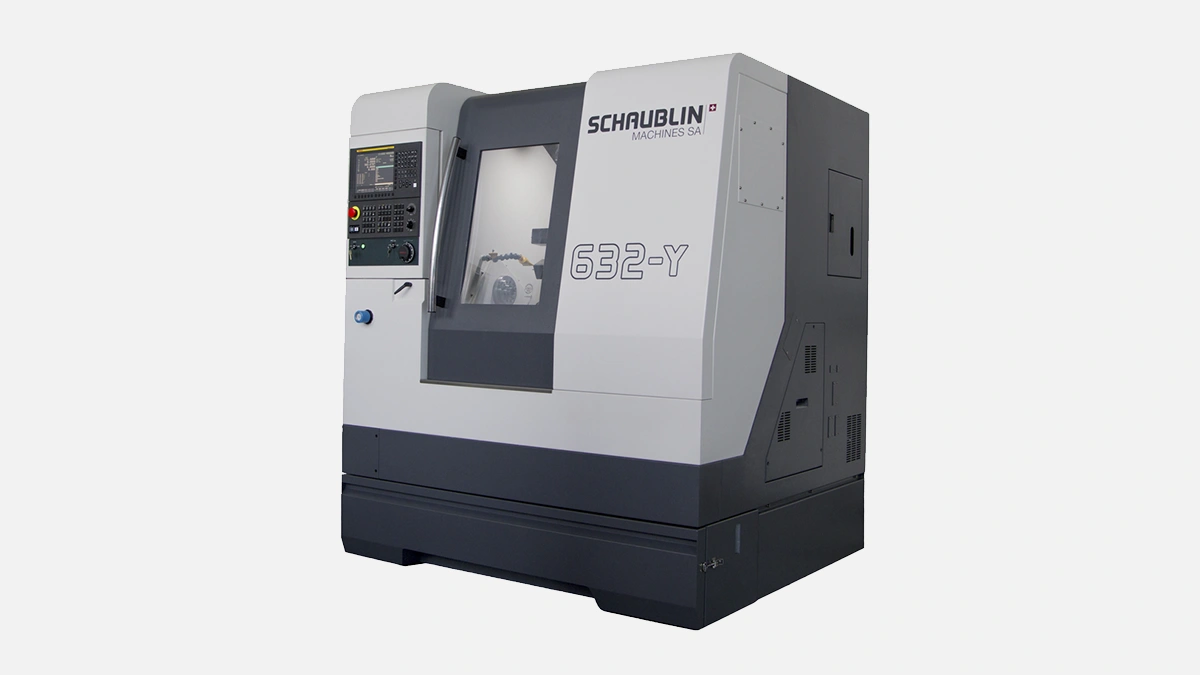
Swiss Y-axis lathe, 6000 rpm, 60 mm Y travel, built for tight UAE shops.
Schaublin, the quiet Swiss kid on the block, has been cutting metal since 1915, give or take a season. First lathes for watchmakers, then bigger toys, finally the 632 series that kept morphing over the last 15 years. Today the Y-CNC variant walks in with a real Y axis, not a gimmick, and that is why shops in Dubai keep whispering about it after Friday prayer.
Two sentences, short. Chips everywhere. Now I dive longer, uncontrolled, into the iron casting that weighs around 5 500 kg, absorbs vibration better than my old pickup absorbs sand dunes outside Liwa, and supports a spindle screaming up to 6 000 rpm without whining. The turret, twelve pockets, bolts straight on the carriage, no slant bed tricks, everything almost vertical so coolant finds its way back down faster than you blink.
Before you scroll, a little table, because people love tables but hate scrolling.
| Axis | Travel | Rapid feed | Comment |
|---|---|---|---|
| X | 210 mm | 30 m/min | Linear guides, dual preload |
| Z | 410 mm | 30 m/min | Beltless direct motor |
| Y | 60 mm | 15 m/min | Real box slide, no shim plates |
Notice the Y throw, only 60 mm on paper, yet in practice that small nudge lets you mill a keyway on diameter 160 mm without reclamping. Saves one setup, maybe two, no exaggeration, I checked on an aerospace gland housing last March.
UAE heat is brutal, coolant turns tepid by lunch, tool offsets walk. Schaublin added a closed-loop chiller around the spindle bearing group, so growth stays under 5 µm during an eight-hour run, at least on a vibe-free foundation. I ran back-to-back tests with a competitor – name starts with N, rhyme withheld – and saw surface finish Ra drop from 1.1 µm to 0.8 µm once I switched. Not a revolution, still enough to skip polishing on some jobs.
Bet you felt that list came out of nowhere, I warned you, my head jumps.
Main motor rated 11 kW continuous, peaks at 15 kW for 30 seconds, torque flat up to about 1 500 rpm then falls. Good for turning Inconel 718 bar 42 mm with a CBN insert, depth 0.4 mm per side, feed 0.18 mm/rev, no stall. I stalled a smaller French machine under those numbers, so there is that.
Within the 632 clan you will meet:
– 632-Standard, plain 2-axis, same bed casting.
– 632-C, driven tools but no Y.
– 632-Y-CNC, the one in question, Y plus polygon turning software block.
Footprint identical, spindle options match, only the Y carriage adds about 300 kg. If floor loading scares you, pick the Standard, but you lose multi-tasking charm.
I threw the 632-Y against three usual suspects, see mini cheat sheet below.
| Model | Y travel mm | Max rpm | Price band | Note |
|---|---|---|---|---|
| Schaublin 632-Y | 60 | 6000 | mid | Swiss build, compact |
| Nakamura WT150 | 80 | 4500 | high | Twin spindle bulkier |
| Hardinge GS-200Y | 50 | 5000 | mid | Belt spindle, longer bed |
| Doosan Lynx 2100LY | 105 | 6000 | low | Sheet-metal lighter |
Yes, the Korean Lynx posts bigger Y, still its sheet metal flexes when you hog 40 Cr steel at 250 m/min. Numbers rarely tell the whole story, Swiss cast iron does.
Fanuc 0i-TF with Manual Guide i, ethernet, DNC thru USB, clipboard cut copy like Windows 98, still works. You can swap to Siemens 828D if your crew breathes ShopTurn, but delivery slips by 6 weeks.
Grout the feet on 300 mm reinforced slab, shim to level under 0.02 mm across bed length. In Abu Dhabi humidity, run de-ionised coolant, bacteria grows slower, nothing worse than that rotten egg haze at 38 °C.
Schaublin turns out roughly 350 of these machines per year, modest versus the Asian giants, still enough to keep spare parts in stock in Zurich and, surprisingly, in Jebel Ali free zone. The 632-Y-CNC lands among shops chasing small to mid-size aerospace fittings, oilfield couplings, even dental implants. What hooks them is simple, rigid Y axis, small floor print, predictable accuracy in hot climates, and an aftertaste of Swiss caution that shows up in every casting corner.
No fairy dust, just cast iron, tight bearings, and a control your night shift already knows. That is often plenty.