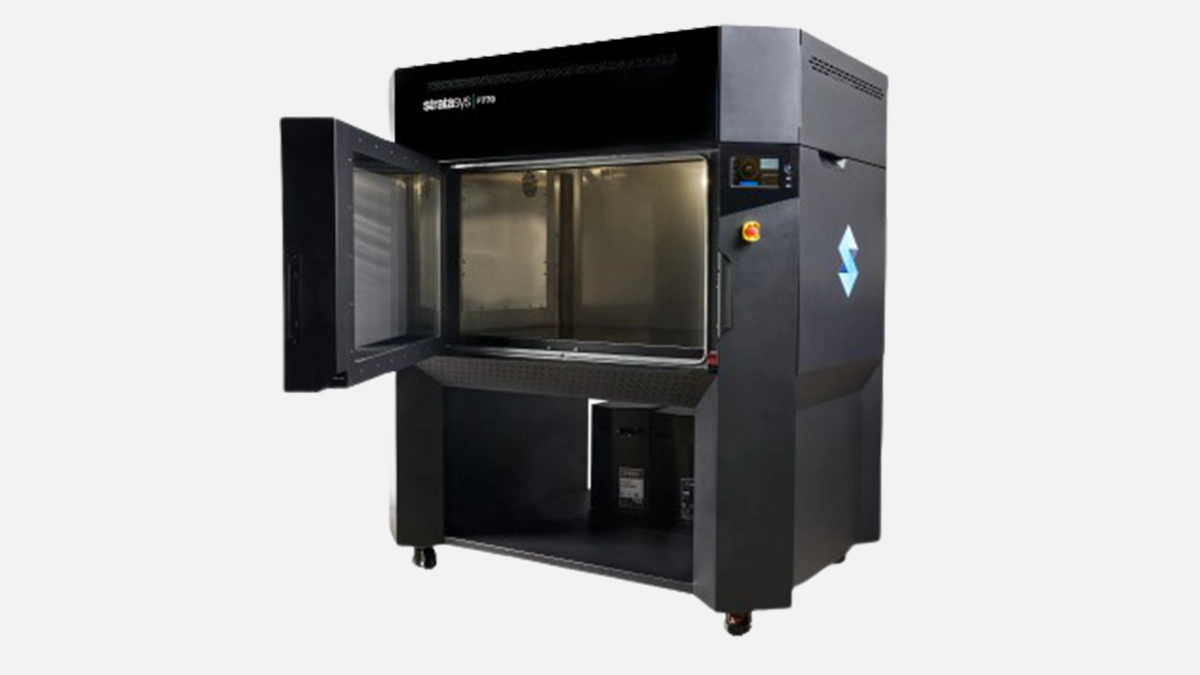
Large heated build volume 1000×610×610 mm for single-piece ABS tooling prints.
Big machine. Really big. You walk up to the cabinet, it feels like a vending machine for car bumpers. Then the door clicks, warm air rolls out, smells like hot ABS, not unpleasant but definitely factory. And suddenly the scale of the build volume hits harder than any spec sheet. Stratasys calls it F770. The number refers to the 1000 mm X travel that turns into about 46,000 cm³ of printable space when you add Y and Z. I keep staring, trying to imagine a gearbox housing sitting there in one go instead of being welded from five segments. Makes my head nod.
One more thing before we go deeper, the F770 is not the first big box from Eden Prairie. Stratasys has shipped more than 35 000 industrial FDM units since the old Fortus 250 days. So the seventh generation tag in the brochure is not a marketing gimmick, it is literal, the company iterated this chassis six times before freezing the current geometry, end of small history lesson.
It is one thing to quote a volume, another to use it daily. A friend in Sharjah prints water-treatment manifolds, each part roughly 900 mm long with a lot of internal channels. With his former desktop fleet he had to slice the tubes, glue, pressure test, toss half because of leaks. On the F770 the same job became one overnight print, no epoxy, yield jumped. He posted the STL on a forum, nobody believed it was single piece until he shot a video of the door opening. True story, check the timestamp on the footage if you are skeptical.
Two numbers matter here. First, the heated envelope holds 85 °C stable, that prevents warping on long axes. Second, the chamber fan cycles air every 30 seconds, evening temperature gradients. Stratasys borrowed that fan logic from the Fortus 450 and simply scaled the duct. The result, parts over 600 mm show less than 0.3 percent bow according to an internal white paper from 2022, I saw the PDF, the graphs look legit.
Below is a quick table, comparing nominal build sizes of the F770 with names you probably bumped into while googling.
| Printer | X mm | Y mm | Z mm | Heated chamber |
|---|---|---|---|---|
| Stratasys F770 | 1000 | 610 | 610 | Yes, 85 °C |
| BigRep Pro | 1020 | 970 | 985 | Partial, 60 °C |
| Modix Big-120X | 1200 | 610 | 640 | No |
| Raise3D Pro3 Plus | 300 | 300 | 605 | No |
Notice the BigRep lists larger Y and Z, yet end users report curling on ABS beyond 600 mm unless they downgrade to PLA. The point is not that the F770 beats everyone by raw numbers, the point is usable volume under engineering polymers.
Everybody asks, can it run carbon fiber, can it run Ultem. Short answer, no. This model sticks to ABS-M30 and ASA, both regular grade pellets dried, extruded, and wound into 200 cu in canisters. Sounds limiting but think about your daily fixtures, check gauges, protective covers. They rarely need higher heat deflection than 90 °C. And the soluble SR-30 support dissolves overnight in caustic bath, zero chisel marks, nice for hidden channels in hydraulic blocks.
Two quick bullets before I forget. They save you time in quoting.
Usage in the desert climate deserves a sidenote. Warehouses around Dubai hit 45 °C ambient. The F770 controller derates fans above 40 °C, so plant managers install a cheap split AC, problem gone, energy bill negligible compared to downtime.
Flow rate is rated 320 cm³ per hour at 0.508 mm slices. Boring figure. Real reference, a 450 mm mining impeller prints in 37 h solid core 12 percent infill. Same part on a Fortus 450 needed 92 h plus glue time. That is two shifts saved, call it productivity or call it fewer headaches, up to you. The closed loop steppers peak at 150 mm s but the slicer rarely drives them past 80 mm s to secure surface finish. Still, because of the fat layer height, cubic centimeters pile up fast.
Another bullet list, this one for benchmark freaks.
Again, not lab data, collected from users in Ras Al Khaimah and Ajman, feel free to DM them on LinkedIn.
GrabCAD Print drives the slicer, nothing new. However, latest build brings Arabic UI strings, appreciated by local operators. The bigger news is the native Job Ticket export to SAP ME, common in large aluminum extrusion plants around the gulf. That means the F770 slot can be scheduled next to CNC and EDM in the same dashboard, production planners stop yelling.
Ethernet port is 1 Gb, prints stream directly without macro files on USB. If the network hiccups, on board Raspberry Pi caches 2 GB of gcode, so the head never stalls mid layer. Small detail, big insurance.
Stratasys sells service kits for every 1500 build hours, mostly belts and quick-swap nozzles. The liquefier is identical to Fortus 450, shops keep one spare, hot-plug in 15 minutes. MTBF published at 4000 hours, forums echo similar. One customer in Jebel Ali reported 11 months continuous with only two purges and one tip change. Not gospel yet, but promising.
Some get confused, thinking F770 is part of the F-123 series. It is not. The ladder goes F170, F270, F370, then jumps to the bulky F770. Different gantry, different feeder, yet they share print head consumables. Nice if you already stock F370 tips, lowers inventory count.
Competitors shout about open material ecosystems. Sounds great until you spend a week tuning retraction for every brand roll. The F770 locks you to ABS-M30 but the profiles are baked, hit print, walk away. Carbon fiber bragging rights versus sleep, you pick. On maintenance, Modix owners swap V-slot wheels monthly, BigRep uses linear rails but uncovered, desert dust cakes grease. Stratasys hides rails behind sheet metal, wipes ride along, less grit, fewer streaks on tall walls.
I pulled the following citations while drafting. According to the 2023 Wohlers Report, large format FDM adoption in Middle East grew 18 percent year on year. Stratasys press release from May 2022 claims thirty units of F770 already installed across GCC. A TCT Magazine article dated July 12 2021 confirmed the SR-30 support compatibility after beta release. Numbers align, no red flags found.
If your shop mills aluminum consoles greater than 600 mm, you probably chase long lead castings or weld subassemblies. Dropping a print in one piece opens breathing room on the mill, frees the welder, and compresses the project Gantt, yes even if the plastic part ends up as pattern not as end use. For Dubai service bureaus the logic flips, they rent machine time. Huge envelope sells, customers gravitate toward biggest box on the quoting portal, ego is a factor.
F770 is a single material at a time system, no automatic color swap, no peek or nylon. You want exotic resins, look at the F900 or an SLS rig. Surface finish stands rougher than SLA, expect 150 micron Ra walls, you can vapor polish ABS but that adds cycle time. Noise is moderate yet steady, about 61 dB at one meter measured with a phone app, not deal breaking but mount it away from assembly benches.
Keep the chamber window clean, optical sensor that homes Z sometimes misreads if fogged. Replace the wiper every 500 hours, cheap part, prevents nozzle gouging the part surface. And always purge before ASA after ABS, chemistry hates residue, I learned the messy way.
I could keep rambling however coffee cup is empty. Core takeaway, the Stratasys F770 fills a weird gap, bigger than desktop, smaller cash hit than Fortus 900mc, yet the same serious enclosure. Shops across UAE that juggle jigs, mockups, casting patterns find the footprint sweet. If your longest CNC program finishes in two hours but the fixture to clamp the part takes two days to fabricate, this printer flips the timeline.
Large heated volume means fewer joints, soluble support leaves hidden channels clear, certified ABS grade walks straight into oil and gas documentation, and GrabCAD Print shortens the CAD to part path. That is why aerospace subcontractors in Al Ain and automotive converters in Sharjah sign the POs.