Build 914×610×914 mm parts in ULTEM or PEKK, reliable chamber heat and soluble support.
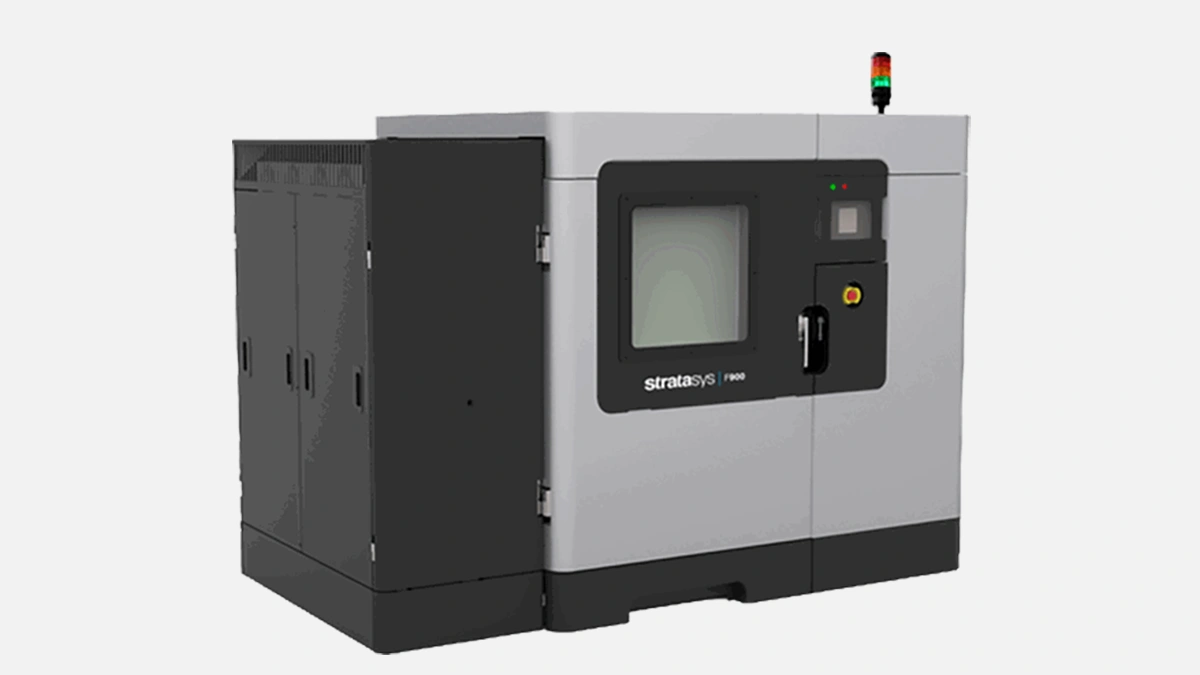
Big box. F900 sticks out in the shop, almost fridge-sized, white panels, that blue Stratasys logo smiling from the door. Blink, and you miss the fact that the build space is 36 × 24 × 36 inches – nearly half a cubic meter. That is why aerospace folks keep parking carbon-fiber lay-ups next to it.
I fire it up, fan whirls, heaters ramp, that smell of warm polymer – kind of plastic popcorn. And, yes, while the name screams “industrial”, operators in Sharjah or Jebel Ali Free Zone still want the same two things, repeatability and parts signed off by QA without drama.
The frame is welded steel, panels are aluminium, nothing fancy, just solid mass. The motion system slides on linear rails, belts on X, screws on Z. Hot ends ride on twin gantries, model material on one side, soluble support on the other, so no hand chiselling.
Before diving deeper, a short cheat-sheet looks handy.
| Area | Data | Why it matters |
|---|---|---|
| Build volume | 914 × 610 × 914 mm | One-piece ducting, battery boxes, no split lines |
| Chamber temp | 200 °C peak | Keeps ULTEM and PEKK layers tight |
| Layer range | 0.127–0.330 mm | Balance surface and cycle time |
| Accuracy | ±0.089 mm | Fits press-fit bushings without hand reaming |
| Footprint | 2.85 × 1.68 × 2.00 m | Fits through standard factory roller door |
| Power draw | ≈ 9 kW peak | Same feed as mid-size CNC mill |
Nothing exotic in the numbers, still, the devil hides in the chamber heater. Polyetherimide softens slow, so you babysit the soak time, let the mass reach equilibrium, then press print. The firmware actually blocks the cycle if thermals drift 5 °C. Good, annoying, both.
I thought, back in 2015, ABS was the king, then oil & gas clients started asking for PEKK and PSU. Stratasys kept adding canisters, so today you swap between:
That mix is more than menu items, it decides if the printer sits idle or pays rent. UAE heat cracks ABS, so many shops flip to ASA in summer, simple as that.
You slice in GrabCAD Print. Interface is clicky, but the presets are not a joke, they are tuned with actual tensile bars. Inside one file you tag the build as machine A or machine B, so if the F900 down the hall has a drifted nozzle offset, job stays parked until a tech recalibrates. Yes, downtime stinks, still better than scrapping 10-kg PEKK brick.
After the part cools, it goes into a caustic tank, support dissolves, you rinse, blow dry, stamp the part with a QA sticker, next.
Marketing PDF says 24-hour build for full volume at 0.25 mm layers. Real world, with ULTEM and rafts, think 36–40 hours. Overnight plus a working day. Operators in Fujairah learned to stagger builds, small ABS parts at night, long ULTEM over weekend, power tariff is lower anyway.
Cutting corners here kills flatness, so everyone just sips coffee and waits.
Belts stretch, heads clog, nothing new. The only unusual task is quarterly calibration of the load cells that measure filament tension, because PEKK dust cakes the pulleys. Stratasys ships a small jig, two screws, five minutes. Ignore it, and you get under-extrusion on left edges, trust me, I chased that ghost for weeks.
Keep them in a drawer, avoids DHL panic.
Competitors? Fortus 450mc, EOS P 810, BigRep PRO.
The 450mc prints the same plastics but caps at 406 mm Z, so if you need truck-scale housings, it is out. EOS uses powder bed, fine for nylon, but PEKK parts turn porous above 20 mm walls, you do extra infiltration. BigRep gives huge volume, yet no heated chamber above 80 °C, forget ULTEM. In sum, F900 is the blunt tool, heavy, less flexible on geometry freedom, though it owns the high-temp, big-size corner.
Stratasys rolled out three hardware revisions since 2008. First batch was branded Fortus 900mc, then 2018 facelift became F900. Rev 3 (2022) got new boards, quieter fans, same chassis. So parts travel between generations with no drama, you can buy used Fortus tips and run them in the fresh F900, handy when budget is tight.
Heat. Electrical grid fluctuation. Dust. The chamber is sealed, yet the underside louver pulls shop air, install the printer away from sand-blasting booth or filters clog daily. Dubai Electricity standard 230 V lines do sag during summer peak, UPS is cheap insurance, keeps heaters stable, parts pass CTQ.
End users here are usually:
– MRO lines at Emirates Engineering chasing cabin brackets
– Oilfield service workshops printing flowline covers
– University labs teaching polymer composites
They all share one need, sturdy parts without hiring a machinist for every iteration. The F900 provides that, eats power, spits plastics, simple trade.
Stratasys has pushed 30 + years in fused deposition, sells roughly 800 industrial units a year, F900 holds the top share by kilogram of polymer pushed through. It may not talk Wi-Fi to your ERP, yet it delivers giant thermoplastic parts in one hit, which for many plants beats having three smaller printers humming in sync. Fin.