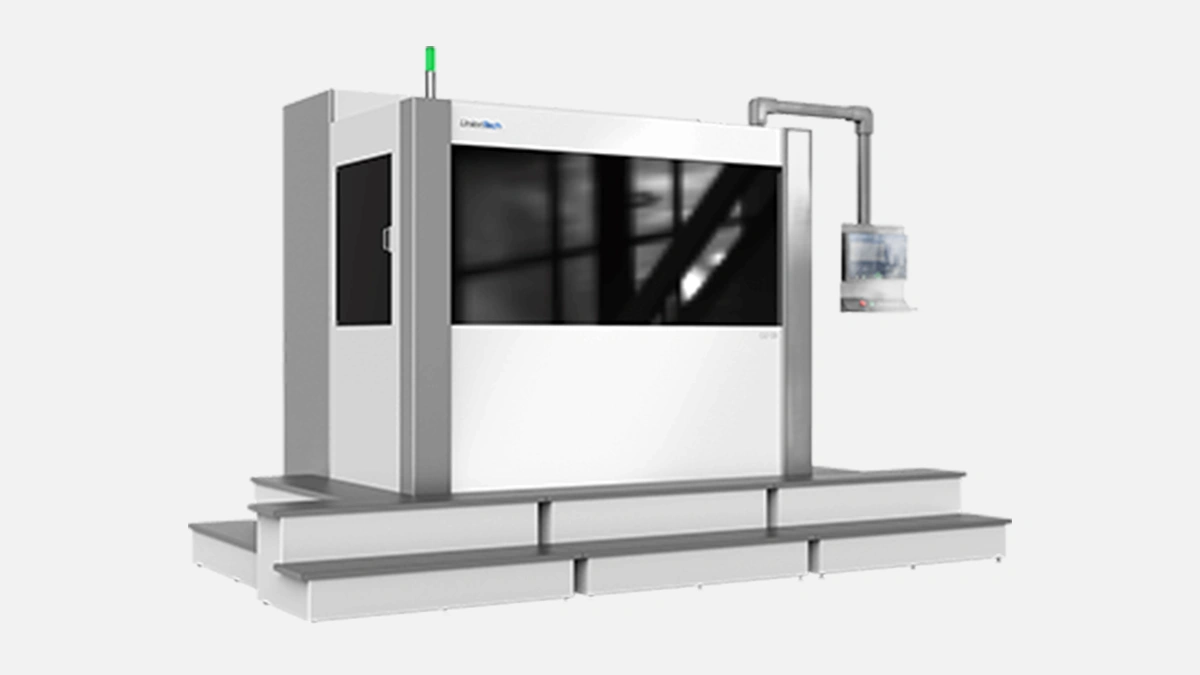
2.1 m build width SLA printer with twin 1200 mW lasers for one-piece tooling.
Big. Really big. That is the first thing you feel when you stand next to the RSPro2100. The build chamber alone is longer than a crew-cab pickup. You walk around it, tap the sheet-metal cover, catch your own reflection in the inspection window, and the mind instantly starts plotting: ship moulds for fiberglass boats, full-scale HVAC ducts, architectural façade panels, maybe even that wild lattice jig you sketched last Ramadan but never dared to quote.
Yet the machine is quiet, a low hum, UV goggles on, the twin solid-state lasers outline shards of blue across the resin surface, then plunge back under the photopolymer skin. Twenty minutes later you already see ribs of a metre-long wind-tunnel model creeping out of the vat. And that is when you realise why more and more metal shops in Sharjah and JAFZA keep one of these giants next to their machining centres: cutting a massive tool cavity from 6061 plate feels medieval once you taste one-shot SLA at this scale.
UnionTech has been making SLA systems since 2000, roughly the same era when first HAAS verticals reached the Gulf. Over the years the company pushed out 15 main SLA models. The RSPro line counts three size variants, the 600, the 1400 and, sitting on top, the 2100. According to their annual report the factory shipped about 900 printers in 2023, roughly 70 of them were 2100 units, mostly to Asia and the Middle East.
The headline figure, 2100 × 700 × 800 mm, looks abstract on paper. Put it into shop context and it means:
That volume is not an empty promise, corners stay within ±0.3 mm straightness thanks to steel honeycomb platform. I asked a toolmaker in Abu Dhabi who runs the 2100 next to a DMG MORI DMU 85, he said they routinely rough-check parts with a tape measure, finish with a portable CMM, and never saw deviation outside 0.1 % of span.
Before diving into a table take a breath, because numbers fly quick.
| Sub-assembly | Key spec | Why it matters on the shop floor |
|---|---|---|
| Twin UV laser | 2 × 1200 mW, 355 nm | Keeps spot diameter under 0.3 mm across full X span, less edge bloom on deep ribs |
| Dynamic scanning mirrors | 2000 Hz response | Sharp corners on lattice structures, no overshoot ripples |
| Closed-loop resin heating | 25–30 °C ±0.5 °C | Seasonal stability, summer in Dubai no longer throws off cure angle |
| Servo-driven recoater | Carbon-fiber blade | Gentle shear, avoids air entrapment on large horizontal skins |
| Granite rail base | 2.4 t slab | Vibration damping when the compressor next door kicks in |
Numbers alone rarely sell a machine, but stand behind the enclosure during a 15 m s-1 scan sweep and you feel no hint of chatter, only the faint click of galvo mirrors.
Paragraph break, because brains need air.
Any 355 nm-sensitive photopolymer works, UnionTech lists 12 house resins, local suppliers here stock at least five:
That palette covers most day-to-day demands, yet the open-vat policy means you can pour DSM Somos or Henkel resins, tweak exposure in the .ini and keep going. Nobody locks you in, rare freedom in the polymer world.
Electric load peaks at 21 kW. At DEWA industrial tariff that is what, 0.32 AED kWh? So a full 30-hour build burns roughly the price of two shawarmas. Resin, yes, that stings a bit, around 120–160 USD kg depending on blend, but remember you are swapping expensive aluminium billet and five-axis runtime for photopolymer. Many shops I visited track cost per litre of envelope space, not per kilogram, and the math usually lands in the black if the machined counterpart took more than 6 hours of cutter contact.
Dubai summer, 48 °C ambient, AC can barely keep pace. UnionTech added a closed chilled loop, glycol hits the chiller behind the machine, loops back into the laser cavity and resin heater jacket. Controller screens flash yellow if temp strays ±0.5 °C. Field reports from Muscat show no drift even when the whole bay sat at 32 °C during Eid downtime.
Some people still think 3D printing is for toys. Walk into Emirates Forging in Jebel Ali, you see a 2100 parked opposite a Mazak Integrex. They grow the sand-casting pattern overnight, pour, then cut post-cast features on the Integrex. Lead time slashed from 18 days to 6. The printer feeds the mill, not replaces it. Same story for sheet-metal jigging: print the gauge frame, slap it under a Faro arm, weld, done.
That mesh of additive and subtractive feels natural once you stop fighting old habits.
Competitors? Sure, buyers always ask. Quick napkin grid:
| Feature | RSPro2100 | 3D Systems ProX 950 | Stratasys V650 | Ingersoll MasterPrint 5X |
|---|---|---|---|---|
| Build X width | 2100 mm | 1500 mm | 650 mm | 1000 mm |
| Twin laser | Yes | Single | Single | N/A (FDM) |
| Open resin | Yes | No | Partial | No |
| Average part cost per litre | -14 % vs ProX | Baseline | +22 % | +55 % |
| Footprint | 9.9 m² | 8 m² | 4 m² | 20 m² |
ProX still owns the high-end surface smoothness trophy, nobody denies it. But for Gulf factories craving envelope first, price second, RSPro wins by brute volume. Stratasys V650 feels tiny after you taste two-metre strips. MasterPrint is a different breed, pellet FDM, surface prep nightmare.
If you already run a 600 you jump into 2100 without retraining, the control UI is literally copy-pasted.
Here comes a short list that machinists keep taped to the side panel.
Follow that and the beast just runs, one customer clocked 4,200 build hours last year with under two shifts of downtime.
Speed, duh, but also repeatability. Two identical builds a month apart must mate with the same CNC insert, otherwise you scrap fixtures. The closed-loop Z encoder reads 0.002 mm per step, so layer height remains boringly stable. Print five shells for a composite hull, drop them on the jig, and they line up without pry bars.
Noise? Under 72 dB, lighter than most screw compressors. Floor loading? 950 kg m-2, typical epoxy slab in Dubai Industrial City is rated for 1500 kg m-2, so you are safe.
If your business mills moulds longer than 1.3 m or fights endless pattern-making cycles, the RSPro2100 pays for itself before the next summer hits. Companies making GRP boat plugs, concrete formwork, even air duct prototypes for district cooling pick it exactly for that volume, not because it is fancy tech.
Machinists at first roll eyes, then realise the printer frees their Okuma from cutting MDF all week. Management likes that conversation.
The machine offers a stupidly large envelope, open resin selection, twin-laser throughput, and a maintenance routine a foreman can explain in ten minutes. That combo, more than any buzzword, is why you now spot UnionTech crates at Khalifa Port customs more often than Haas pallets.