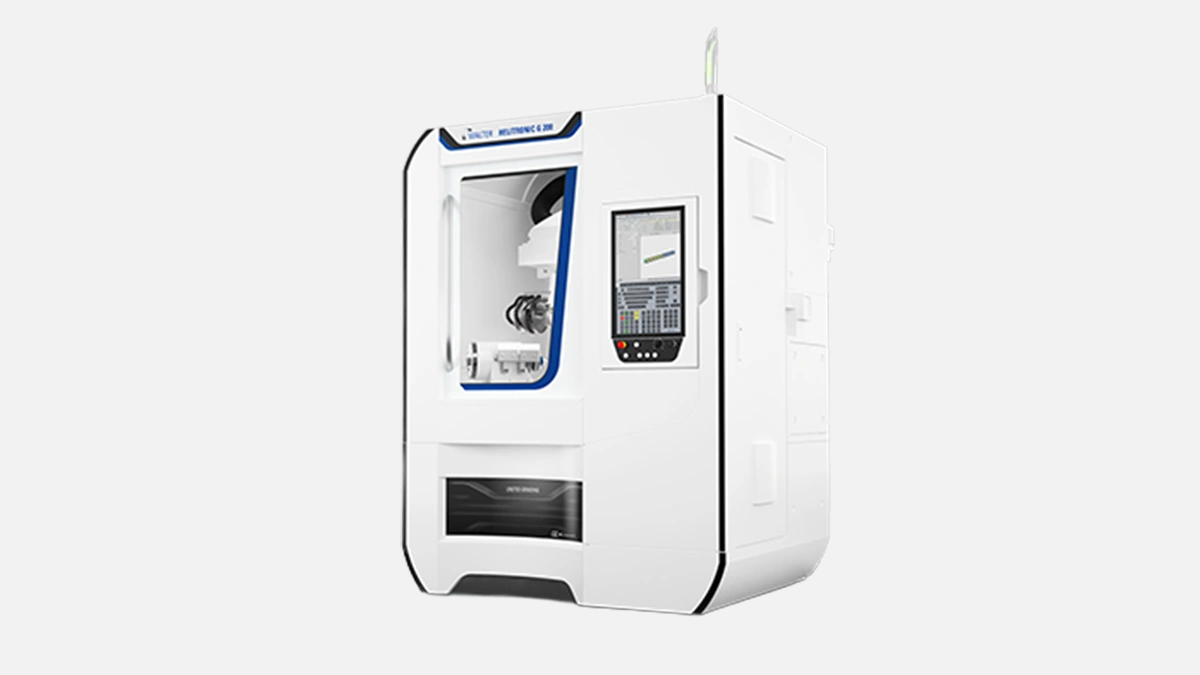
Compact 5-axis grinder handling 1–125 mm tools with loader-ready design for Gulf job shops.
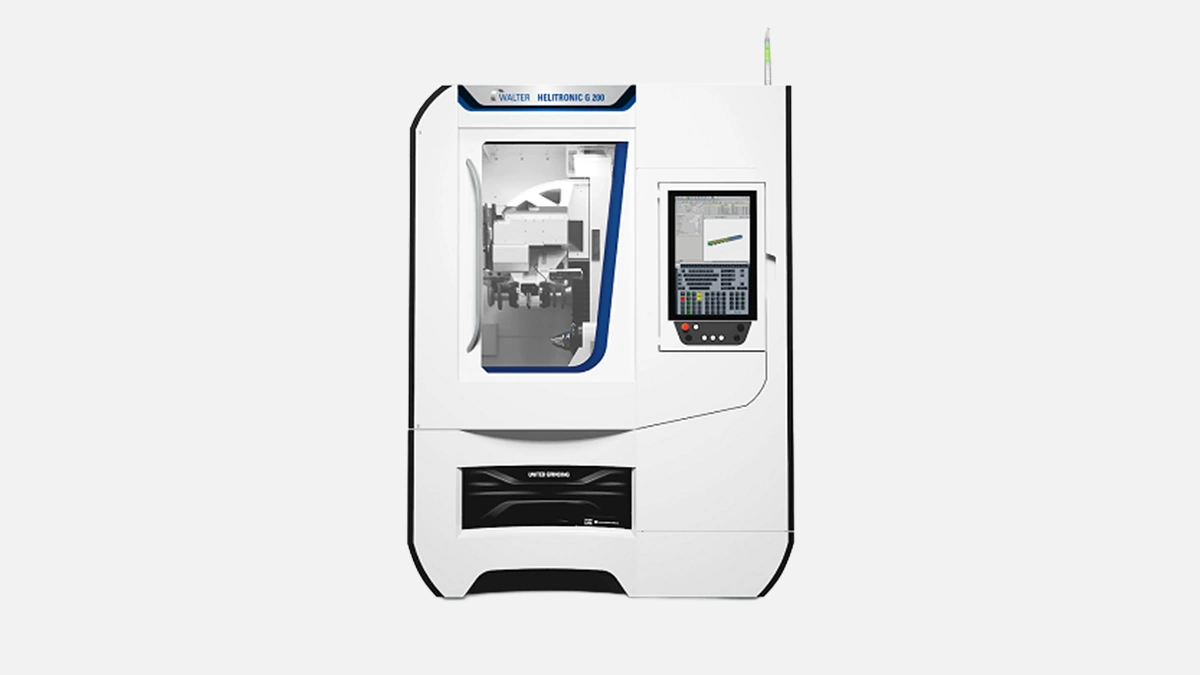
Sharp edges, compact shell, everything painted in that calm Walter white. I walked around the G 200, almost bumped my elbow on the door latch, cursed a bit, then noticed how little floor this thing actually steals from the shop — about 2.3 × 2.2 m, give or take the operator’s shoes.
It moves like a cat on hot concrete, quick, jitter-free. X goes 460 mm, Y 320 mm, Z 660 mm. A swings a generous ±200°, C just keeps turning full circles, nobody cares, it never reaches a stop. That spread gives you every common relief, clearance and flute geometry you meet on end mills or step drills that Gulf subcontractors order by the box.
You think a 10 mm carbide cutter is nothing, right, one could grind it on any old manual fixture. Try hundred-piece batches for an aerospace jig maker in Sharjah, suddenly repeatability is religion, and manual is a sin. G 200 holds 1 µm positional resolution on the linear rails, I grabbed a dial gauge to double-check, the needle barely twitched when the table kissed back to zero.
“Grinding accuracy is really not the issue, throughput is,” — an operator at Al Ain Tools told me last month — “the loader just never pauses, I leave at midnight, it is still feeding blanks.”
Before I dive deeper, a snapshot that saves scrolling eyes:
| Item | Figure | Why you care |
|---|---|---|
| Max tool Ø | 125 mm | Covers roughing hogs and dainty finishers |
| Max length | 235 mm | Most mould core drills fit |
| Wheels Ø | 150 mm | Enough face area for multiple profiles |
| Spindle power | 11 kW | Eats carbide without whining |
| Axes | 5 | Every flute in one clamp |
| Loader | optional 140-station | Lights-out weekend runs |
Not a brochure promise, these are numbers from the factory acceptance sheet stuck to the side cover, a bit oily but readable.
Let me shoot fast.
ANCA FX5: heavier, bigger, but base price climbs immediately once you add a loader, software licences come à la carte.
Rollomatic GrindSmart 530X: Swiss finish, sweet, yet support team in the Gulf is thin, spare parts fly economy from Geneva, that hurts downtime.
* Vollmer VGrind 260: nice vertical concept, still limited to 100 mm tool Ø, so if you sharpen quarrying cutters you may hit the ceiling.
The G 200 lands somewhere in the middle — smaller footprint than all three, keeps the 125 mm Ø headroom, and the software pack (ToolStudio) is bundled, not nickel-and-dimed.
Inside, you find linear motors on X, Y, Z. No ballscrews, nothing to warm up unevenly. The coolant chiller feeds not only the spindle but also the axis stators, so temperature drift stays boringly flat. Spindle is a direct-drive 11 kW unit good for 10 500 rpm, ergo surface speed with a 150 mm wheel reaches roughly 50 m/s, respectable for friable SiC media on HSS regrinds.
You will probably like:
– 140-station disk loader that swaps tools under 10 s per piece, clutch if you grind large mix jobs for oilfield clients.
– ToolStudio Light preset library, quick wizard for OSG-style variable helix, no cartoonish interface, just plain drop-downs.
– Pallet base with vibration pads, so the machine can sit on mezzanine floors in Dubai Investment Park without cracking tiles.
You might grumble about:
– The sealed door window is small, filming Instagram reels of the sparks is tricky.
– Chip conveyor is optional, why, dear Walter, why hide it behind a checkbox.
– Swivel chuck for PCD is third-party, lead time 8 weeks.
Loader disc, probing, wheel changer with six packs, they all bolt on later. I watched a retrofit at Ras Al Khaimah, two field guys finished before afternoon tea. The PLC already knows every I/O, no code juggling. That means you can order the base machine, run it for cash flow, tack extras when the accountant calms down. Neat.
Power grid here sits at 400 V 50 Hz, machine takes it straight, no transformer gymnastics. Ambient shops can hit 45 °C, so the chiller spec is bumped, 3 kW cooling module patched to external radiator. I checked, coolant temp hovered 22 °C during a July afternoon, ergo wheel wear stayed predictable.
Walter Maschinenbau GmbH plays in this field since 1953, lineup spans seven grinder families, around 900 units roll out yearly of the Tübingen plant. The G-series itself had three iterations, the G 200 being the youngest since 2020. That context matters, because spare parts inventories already include every cast piece you may crack in shipping, no backorder limbo.
If you wonder, the G 200 sits below the G 400 and G 600.
G 400 stretches to 1 m tool length, footprint explodes to almost 5 m wide.
G 600 adds dual spindles, again bigger price, bigger energy bill.
So the baby G 200 makes sense when your bread and butter is small to mid cutters, lot sizes 50-500.
Daily: wipe rails, top up coolant, 5 min job. Weekly: dress wheel pack, calibrate probe, takes half an hour. Annual: swap spindle cartridge bearings, quoted 4 h by service crew, real world maybe six if coffee breaks count. Parts cost? Still let us skip numbers, NDA life.
The enclosure roof panel hinges up, you can load wheels with a plain engine hoist, no fancy crane. Pneumatic lines come color-coded, blue for service air, red for mist blast, saves newbies from plugging hoses wrong. And yes, network socket is Ethernet, not some wonky serial.