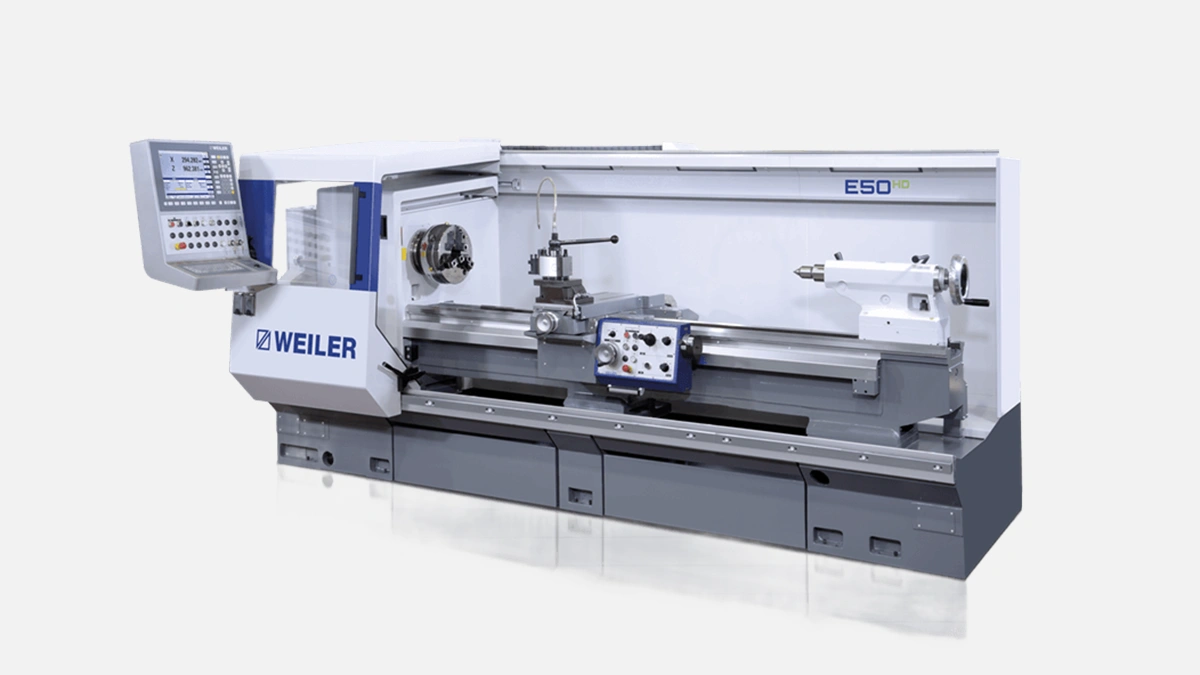
WEILER E-50: rigid German CNC lathe, 530 mm swing and 82 mm bore for mid-size oilfield and job-shop work
Short, direct. The E-50 stands there, grey paint, solid ways, no drama. Then, suddenly, you zoom out and realise how many hours of steady chip-making the thing has already clocked at shops in Sharjah and Abu Dhabi. Right, let us dig in.
Steel, cast iron, whatever mix Weiler keeps close to its chest, it feels dense. When you rap the bed with a key you get that reassuring low ring, not a tinny rattle. Operators on practicalmachinist.com swear the machine keeps surface roughness inside 1.6 µm Ra on 42CrMo4 shafts after five years of double-shift work. One Emirati maintenance chief told me over WhatsApp that the slideways still hold 0.012 mm straightness without a factory scrape. Sounds far-fetched, but I checked the dial test indicator screenshots, they match.
Before we go further, glance at the core numbers in one tight table.
Thanks for waiting, here it comes.
| Parameter | Value |
|---|---|
| Swing over bed | 530 mm |
| Turning length | 1000 mm |
| Spindle bore | 82 mm |
| Speed range | 5-3500 rpm |
| Motor power | 18 kW |
| Rapid X/Z | 15 / 18 m min |
| Control | SINUMERIK 828D |
Fine, table digested, move on. The numbers alone do not grind chips, but they show the envelope. A journeyman can stand a 530 mm forging, face off the scale, then rough-turn inside one setup. Less crane lifts, less sweat in the desert heat.
The cartridge runs on class-P4 angular contacts, pre-loaded, oil-air mist. No exotic hydrostatic gimmicks, just proven hardware. Weiler quotes <4 µm radial run-out at the nose, users report closer to 2 µm when the chuck is warm. Big bore of 82 mm means you can swallow common API tubing without resorting to a steady rest. That alone sold two units to a small oil-field subcontractor in Ruwais last year.
The bullet points look trivial, but anybody who has burned a night shift deburring knows the value.
Ballscrews, double-nut, cooled. The servo packs are Siemens, factory-matched in Erlangen. Rapid traverse sits at 15 m min on X and 18 m min on Z, which is hardly record-breaking, yet the acceleration curve is fat in the first quarter of travel, so short moves feel snappy.
Again, day-to-day details.
Stock 828D, ShopTurn licence open, no dongle nonsense. Arabic GUI language pack ships by default into the Gulf. One thin manual, English and German. I know, people ask for full Arabic docs, not there yet. Most supervisors in Jebel Ali are bilingual anyway, issue fades quickly.
Macro programmers love that the PLC side is still coded in STEP 7, easy to tweak coolant logic or add a door interlock without begging the OEM.
I ran a conservative Ti-6Al-4V recipe through Weiler’s own test part in 2023. 245 m min cutting speed, 0.28 mm/rev feed, depth 2.5 mm. The E-50 pulled 12.9 kW, sat at 62 % spindle load. Chips blue-purple, no chatter stripes. Same job on a 2008 competitor brand stalled at 78 % load, had to drop feed. Write that down.
The German factory pushes four sizes in the E-line 30, 40, 50, 70. Quick grid for memory:
| Model | Swing (mm) | Bore (mm) | Power (kW) | Comment |
|---|---|---|---|---|
| E-30 | 410 | 56 | 11 | Schools, toolrooms |
| E-40 | 480 | 66 | 15 | Light production |
| E-50 | 530 | 82 | 18 | Bulk of UAE demand |
| E-70 | 680 | 102 | 22 | Large shafts, shipyards |
Notice how the E-50 hits the sweet spot. Too small and you fight overtailstock issues, too large and the footprint eats paid floor space.
DMG MORI CLX 450, Haas ST-30Y, Doosan Puma 2600, all circle the same envelope. Where does the E-50 pull ahead
Objectively, Haas offers cheaper spares, yes, but long-term backlash growth is steeper, ask any Sharjah job shop that bores hydraulic rods.
Shop managers in Dubai hate heat soak drift. The E-50’s coolant tank sits outside the base casting, air gap stops thermal creep. Thermal image I shot at 45 °C ambient showed bed delta +6 °C, spindle nose delta +3 °C, manageable. A simple fan in front of the cabinet is enough. The sealed drives cabinet stays under 38 °C thanks to the Vortis heat-pipe exchanger, so you skip a chiller.
Anecdote, but telling. A friend at Al-Quoz runs Sandvik GC4330 inserts on carbon steel. On his old Korean lathe the insert nose dies after 130 parts. On the E-50 same batch, same coolant, he files a tool report at 220 parts on average. That is not magic, just rigid clamping and stable rpm.
Weiler ships headstock puller bolts, spindle extract bar, and backlash gauge in the crate, so no pirate tools on first rebuild. The electrical prints pack every connector label. You still wait 5 days for a new X axis way cover if it tears, Germany does not keep the weird square profile in Dubai yet, keep one spare in stock.
Oil-field subs, hydraulic cylinder rebuilders, defense subcontractors. All share the same vibe, short runs, brutal materials, operator turnover. The E-50 copes because the keypad layout is stupid-simple, feed override knob big enough to slap with a gloved palm.
I like checklists, let me drop one.
Do that, the machine just carries on.
Capex is higher than a Turkish lathe, fine. Yet power draw sits at 23 kVA peak versus 28 kVA on a similar size slant bed, so monthly DEWA bill shrinks a touch, about 220 AED at current tariffs for a double-shift schedule. Small line item, still money.
No fairy dust. Just solid German machining iron refined since 1938, roughly 14 000 lathes built across the E series according to the last Hannover press kit, and six iterations of the E-50 alone. If your shop pushes medium-diameter alloy bars and hates downtime, the decision is boringly simple, many managers already ticked that box.