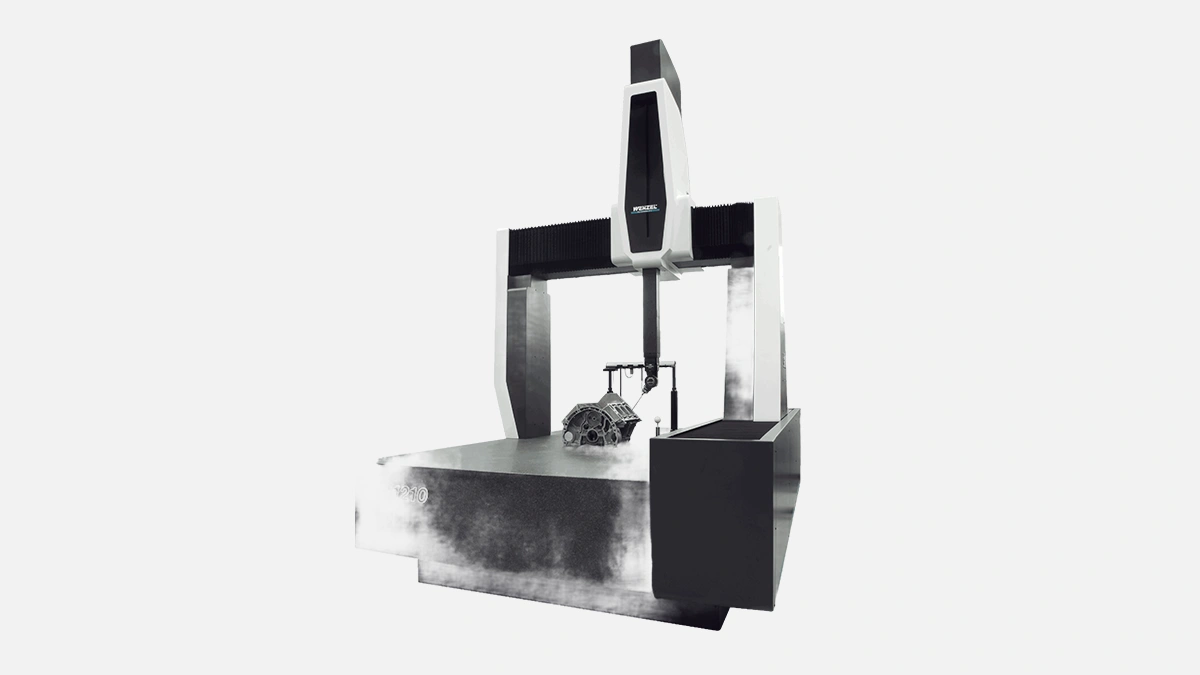
Bridge-type CMM, 1200×2000×1000 mm volume, 2.5 µm accuracy, handles 3.5 t parts.
Short intro first. Big bridge, heavy granite, air cushions, you look at it and think wow, this thing eats tolerances for breakfast. Then a long winding remark, because the numbers on the badge – 1200 × 2000 × 1000 mm envelope – sound ordinary on paper yet on a noisy shop floor in Sharjah they actually matter, the operator can reach the far corner without praying the styli will snap.
Chunky legs, compressed air flowing, minimal friction, no drama. People often forget, the bridge on the LH series is not cast iron, it is a composite of granite and alloy, so vibrations get killed fast, machines stay quiet. I watched a tech slam a 2 t stainless rotor on the table, dial gauge barely twitched. Sure, you still need decent foundations, nothing magical.
Before numbers clutter the page, let me lay down a quick list.
– Air bearing guideways on all axes, nothing touches, no stick-slip
– Dual drive on Y, so the carriage does not crab when you accelerate
– Hidden cable chain, less dust buildup in Gulf humidity
Three lines, enough. Back to thoughts. The Y beam spans two metres, most bridge CMMs in this size class sag a little in the middle, Wenzel uses a steel tension rod system, simple, effective, avoid overengineering.
I like the default Renishaw PH10M, rotate, index, fine. Some shops bolt on a REVO head, pricey, but if you chase blade edges in aerospace you pay, no questions. Swapping modules is bluntly fast, magnet latch, five seconds and the stylus rack looks like a toolbox exploded. A friend in Abu Dhabi keeps two racks pre-loaded, swaps between conventional touch and SP25 scanning all day, no recalibrate each time, machine memory handles offsets.
Bullet list number two coming, brace.
* Available styli lengths up to 800 mm, yet the deflection stays within spec
* Quick-thread adapter allows hybrid laser sensor on same port
* Firmware already knows ISO 10360-12 routines, less paperwork
Enough bullets, continue. The controller is a Renishaw UCC T5 tucked in the pedestal, Ethernet link, you can park the PC twenty meters away if the metrology room is glassed off. Interesting sidenote (yeah I wander), the German factory tested radio interference up to 25 GHz, no issues next to 5G repeaters, so plant-wide Wi-Fi is safe.
Dubai summer hits 50 °C outside, step into the bay, chiller works overtime. The LH 1210 does not pretend to live in a lab, it tracks temperature with PT100 sensors on every axis, pushes data into the compensation map, linear plus volumetric. So a 4 °C drift across the bridge converts to roughly 1 µm error on a one-meter bar, well inside spec. Important, the machine needs stable airflow, not arctic blasts from the top, easier to achieve than full climate control.
A small table for the curious. Numbers speak louder.
| Feature | LH 1210 | Typical 12-20-10 gantry rival | Impact on shop floor |
|---|---|---|---|
| MPE_E µm | 2.5 + L/250 | 3.0 + L/200 | Tighter, less re-inspection |
| Max part load kg | 3500 | 2500 | Load rotors, molds without crane gymnastics |
| Acceler. mm/s² | 2400 | 1500 | Faster point cloud build |
| Air consumption Nl/min | 110 | 160 | Smaller compressor works |
See, table done, let’s move on. Notice how the description hugged the table from both sides, teacher would be proud.
WM | Quartis, odd name, neat tricks. The ribbon UI looks dated, yet the logic flow suits machinists, not coders. Create alignment, pick CAD faces, run, export to Q-DAS, done. Scripting uses plain text, an operator at Ras Al Khaimah wrote a macro to batch inspect 240 brake caliper bodies overnight, zero human in loop. If you live in PMI world, import the GD&T directly, the software highlights tolerance balloons, saves you scrolling PDFs.
Wenzel sells roughly 1500 machines a year, about 200 of them are LH family, numbers from their 2023 report, not rumors. Inside the family you bump into LH 108, 1210, 1515. Quick compare:
| Model | Volume mm | Footprint mm | Max load kg |
|---|---|---|---|
| LH 108 | 1000 × 1800 × 800 | 2800 × 4200 | 2500 |
| LH 1210 | 1200 × 2000 × 1000 | 3100 × 4700 | 3500 |
| LH 1515 | 1500 × 3000 × 1500 | 3700 × 6100 | 7000 |
Why pick 1210, not 1515, if cash not a problem? Simple, crane capacity, floor space, and you rarely need 1.5 m Z unless measuring casting trees. 1210 is the middle ground, fits through a 4 m roll-up door, electrical cabinet plugs into a standard 400 V 3-phase feed, no substation upgrade.
Some closing, scattered thoughts. Automotive subcontractors love the speed. Aerospace outfits chase the volumetric accuracy, add scanning heads, good. Mold shops in Ajman appreciate the granite table finish, they set the electrodes directly on it, fewer setups.
Final paragraph, promise. The LH 1210 stacks three big advantages in real life: generous measuring volume without hogging floor, accuracy spec that survives Gulf heat, and a bridge stiff enough to let you hammer through 8000 points per minute without babysitting the stylus. That cocktail explains why turbine blade grinders, hydraulic valve houses, even 3-D printing bureaus sign purchase orders despite the paperwork headache that always comes with German machinery.