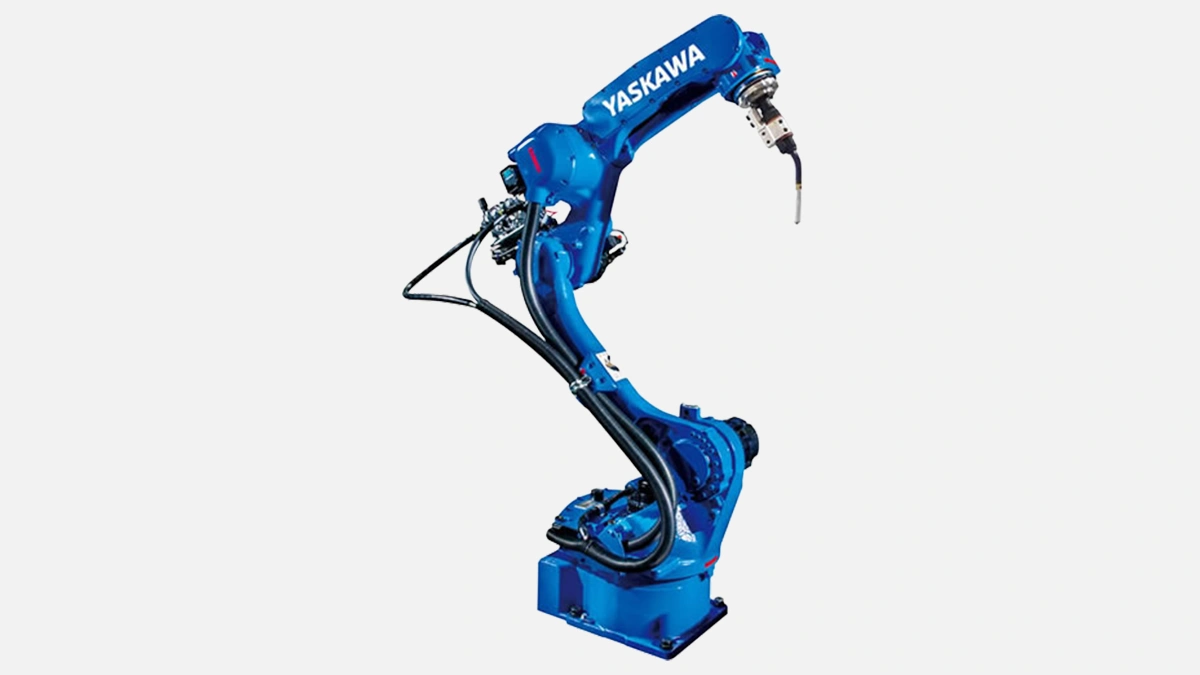
6-axis welding robot, 12 kg payload, 1 440 mm reach, built for nonstop arc jobs
Short line. Snap. You walk into a shop in Sharjah and this slim blue arm is humming in the corner, torch spitting sparks all day, nobody babysits it, nobody worries it will miss the joint, the supervisors are busy elsewhere. Then the thought jumps around your head, wait, the part count keeps rising, yet the robot is barely warm. Right, let us unpack why.
Yaskawa Electric has been building electric motors since 1915 and industrial robots since 1977. Today the tally of shipped units is well past 500 000. The AR family alone covers five payload steps, AR700 up to AR1730, so the AR1440 sits squarely in the middle, the practical sweet spot for light fixtures and general fabrication. There have been two hardware revisions, both backward-compatible with the same YRC1000 controller, so spare boards are never a scavenger hunt.
Before diving deeper check the plain numbers, they rarely lie.
| Metric | Value |
|---|---|
| Payload | 12 kg |
| Reach (hor) | 1 440 mm |
| Reach (vert) | 2 511 mm |
| Repeatability | ±0.04 mm |
| Axis speed S/L/U/R/B/T | 260/260/360/410/410/630 deg per s |
| Footprint | Ø 165 mm bolt circle |
| Weight | 145 kg |
| Controller | YRC1000 |
Numbers end, story starts. What those digits whisper: slender envelope, no wasted swing, fits between press brakes that already occupy the pricey floor space in Dubai Industrial City. The wrist is slim too, only 42 mm wide so it sneaks between fixtures without torch crash.
Official sheet shouts 12 kg, yet practical users on the WeldingWeb forum mention sticking a 4-metre water-cooled torch and still having 3 kg headroom for dress-out. The hollow wrist lets the cable run inside, fewer snags, fewer cable flips, less downtime, plain simple. One fabricator from Abu Dhabi Marine yards wrote last year that after 18 000 arc hours the cable is still original, the only change was the tip kit.
Power tariffs climb, skilled welders jump ship to bigger projects, delivery times still shrink. The AR1440 keeps a steady 40 inches per minute fillet on mild steel, with hardly any spatter thanks to built-in weave macros. What that means for a gate manufacturer in Ajman: one robot covers the work of three manual welders on standard balcony railings, electricity bill barely budges.
A quick list, but let me first breathe. Okay.
Some daily benefits the crews report:
Yeah, simple bullets, but the shop talk keeps rolling.
You can pair the arm with Fronius TPSi, Lincoln Power Wave, or Kemppi A7, via Analog, EtherNet/IP, or ProfiNet. No extra gateway, all protocols sit inside the YRC1000. First day you jog it with the small pendant, clumsy thumbs, second day you realise the teach button vibro feedback feels nice, third day the operator already records touch sensing. Programming a weave pattern is three screens, done, go home earlier.
Pause, mental picture. Axis 2 can tuck the elbow -100°, so the torch dives under the part, sweet for inside corners. Axis 6 spins ±455°, so wrist rotation rarely hits a soft limit, cycle times drop because you do not waste time unwinding.
Before the brain melts here is what the maintenance guys usually highlight after six months:
They like that, downtime is kryptonite.
Heading says it. You know the rivals: FANUC ArcMate 120iD, OTC FD-B6, ABB IRB 1600ID. Table time again, but shorter.
| Model | Payload | Reach | Repeatability | Controller weight |
|---|---|---|---|---|
| Yaskawa AR1440 | 12 kg | 1 440 mm | ±0.04 mm | 70 kg |
| FANUC 120iD | 25 kg | 1 831 mm | ±0.02 mm | 180 kg |
| OTC FD-B6 | 6 kg | 1 444 mm | ±0.08 mm | 90 kg |
| ABB 1600ID | 10 kg | 1 450 mm | ±0.05 mm | 90 kg |
Fanuc offers longer reach but brings a heftier body, so cell fencing grows, cost of guarding spikes. OTC is lighter but payload half, meaning heavy water-cooled torches are risky. ABB similar but lacks the through-arm cable cavity diameter demanded by thick hybrid hoses. Therefore many choose the blue arm, balanced middle road.
The AR family looks like this:
Same controller, same pendant, so scaling production is swapping the arm and reflashing parameters, no drama.
YRC1000 stands at 598×490×427 mm, about the size of a hotel minibar, yet drives up to 4 external axes directly. So positioners for oilfield flanges or H-frame sky hooks bolt in and listen on the same EtherCAT bus. Cooling is straight air, all boards conformal coated, humidity in Fujairah workshops will not fry them. One user dropped a note on LinkedIn, the cabinet survived 55 °C ambient last August when the AC failed, the robot merely slowed duty cycle by 8 % according to log files, still welded.
MotoSim EG-VRC, the offline tool, imports STEP, parasolid, IGES, whatever, so the design office at Jebel Ali Free Zone can lay out cell paths while the real robot keeps burning wire. Transfer goes by USB or Ethernet, plain old network share, no dogmatic IT hoops.
Inside the pendant there is built-in arc sensor package, optional laser seam finder plugs through a UR cap, wait scratch that, not UR, this is Yaskawa, the accessory is called ComArc II, frequency modulated, tolerance window ±3 mm in Z, tightening the rework loop.
Yaskawa publishes cycle utility rates, average power draw when welding at 300 A is 4.5 kW including source, yet idle draw robot alone sits at 0.8 kW. Over a year of two-shift operation, the difference vs older MA1400 adds up to roughly 14 000 AED energy savings, humble but still a spool worth of stainless wire every month.
Picture a simple J-shaped table, robot on the corner, turntable in front, operator loads side A while robot welds side B, flip, repeat. The AR1440 cable bundle passes through the hollow wrist, so clearance above the jig stays at 110 mm even when the part rotates, no snag. That is what the mezzanine railing maker in Abu Dhabi appreciated, they report zero torch cable replacements in fourteen months.
No rose lens, there are quirks. Teach pendant UI still stuck in the late 2000s visual vibes, grey buttons, odd menu logic. The default servo smooth setting feels sluggish, you need to raise the S-curve tweak to 60 to get brisk travel, newbies rarely know that. Also the coolant hose inside the wrist takes finesse during installation, if you twist past 180° on axis six while pushing the hose, the inner liner kinks, later it leaks. Small things, but mention them.
Let the words flow first. Now list.
Done, breathe out.
Metal furniture shops in Sharjah, skid frame builders in Ras Al Khaimah, pressure vessel outfits near Ruwais. All share one itch: repetitive fillet welds, low mix high volume, mild or stainless up to 8 mm. The AR1440 scratches that itch, keeps arc on part above 85 % shift time per log, managers smile.
Small footprint, enough reach for most chassis, wrist cabling hidden, controller compact, service parts everywhere in GCC warehouses. People were sceptical, then they saw the hourly log, ok fair enough, they signed. That is the story.
Drop curtain.