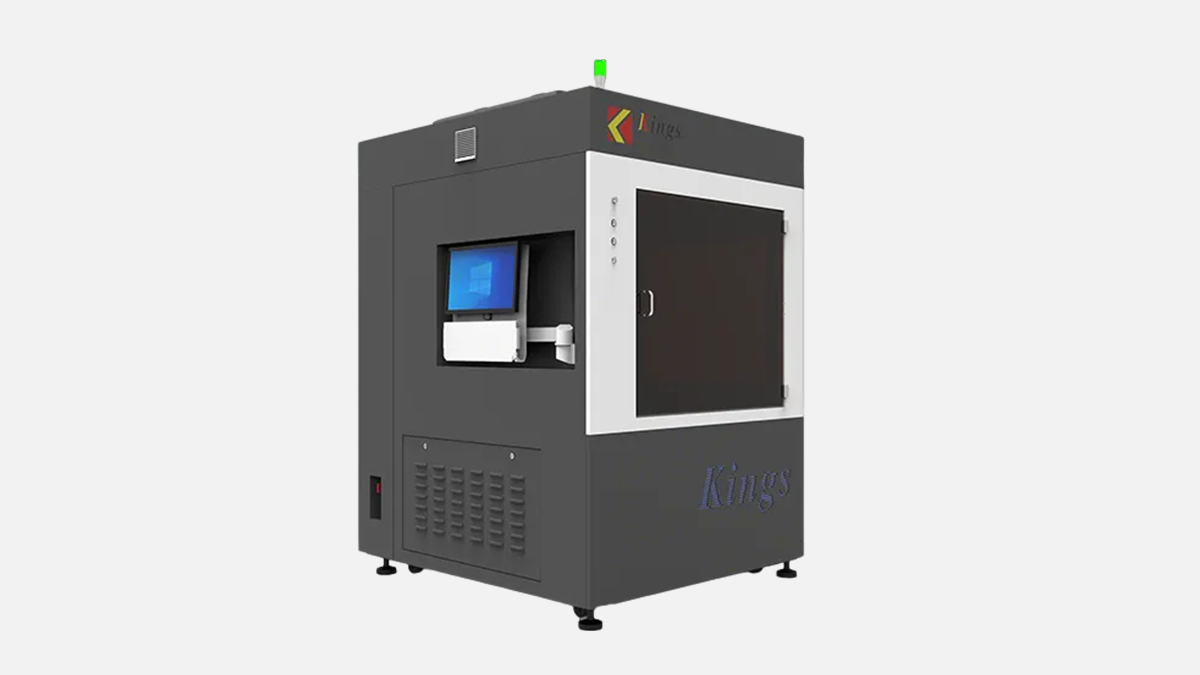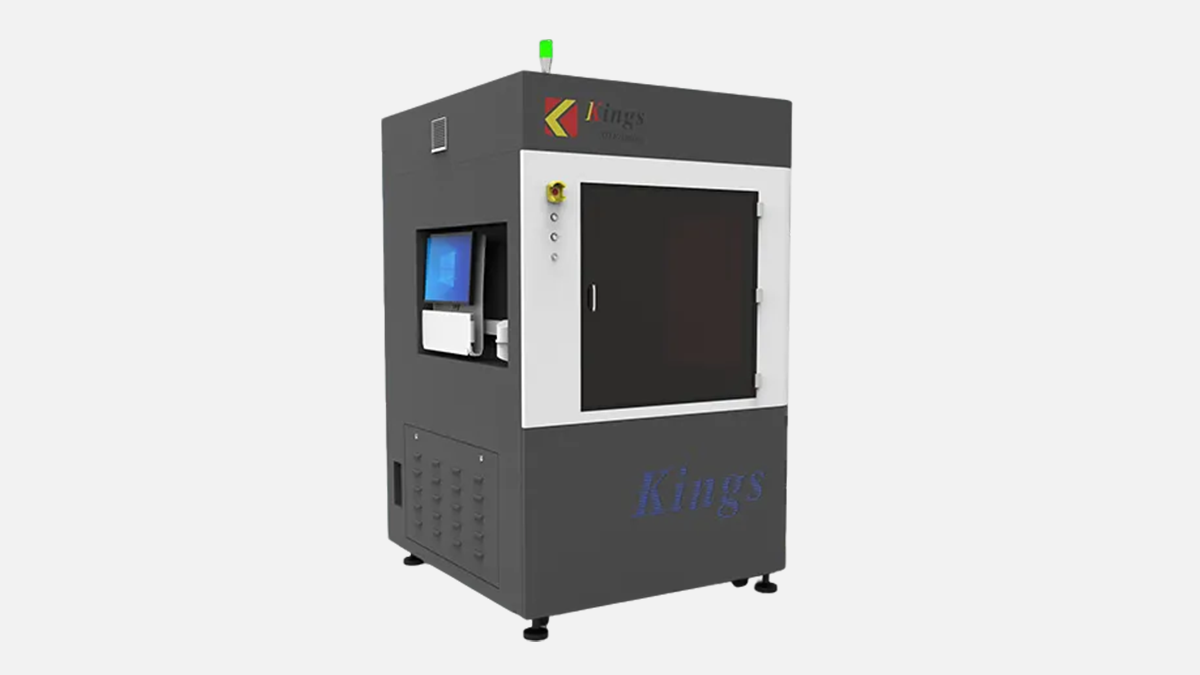
Large format SLA printer with 850 x 850 x 500 mm build and variable beam for accurate patterns and prototypes.
Kings SLA 850 Pro is a large format stereolithography resin printer built around a UV laser and a rigid motion platform. In a metalworking business, this machine is not competing with your CNC mills and lathes. It is a support machine for patterns, fit checks, and tooling aids when you need shape complexity without programming, fixturing, and chip-making time.
The core decision with this model is simple. If you regularly need resin parts up to 850 × 850 × 500 mm, and you want a variable laser spot for balancing detail and throughput, the 850 Pro is positioned right in that space.
Before you think about materials and applications, look at the machine as a set of constraints. The build envelope, power requirement, and resin tank capacity tell you what kind of jobs it can run comfortably. The published laser and motion specs tell you what kind of surface finish and feature size you can realistically aim for.
Key published points for Kings SLA 850 Pro include the items below, which are the ones that usually decide layout, utilities, and job planning in a production environment.
In practice, these numbers mean you plan the printer like a heavy industrial asset, not like an office prototyping tool. It needs a stable floor, controlled environment, and a dedicated workflow for washing and curing.
The main reason to choose this model is the working volume of 850 × 850 × 500 mm. In real workshops, that dimension set is valuable because it fits large one-piece patterns, large inspection fixtures, and full scale mockups that you would otherwise split into segments and bond. Splitting is not only labor, it is also alignment error and extra surface work.
To make the envelope useful, you need a clear rule for what goes inside as one piece and what you still split. A practical way is to decide based on assembly tolerance and the time you can spend on finishing.
A simple planning checklist for part size decisions is below.
After you define those rules, the 850 × 850 × 500 mm build becomes a predictable resource. Your programmers and toolmakers stop debating part by part, and your planning becomes repeatable.
Kings publishes an accuracy model that is important to read correctly. It is specified as ±0.1 mm for part length up to 100 mm, and ±0.1% of length for parts above 100 mm. This type of statement is common on large format resin machines, because the absolute error grows with size and geometry.
What matters in metalworking is how you translate that into decisions like allowance for casting patterns, machining stock, and fit checks. Here is a practical example using the published rule. If a critical span on your pattern is 500 mm, the stated model implies ±0.5 mm on that span from the percentage term.
This does not mean every feature will be off by 0.5 mm. It means you should treat the printed part as a controlled reference for geometry, but you still design allowances where metal meets metal.
Layer thickness is published as 0.05 to 0.2 mm. For most industrial work, you will not run 0.05 mm on the entire job unless surface detail is the primary goal. Large metalworking patterns often benefit from thicker layers on bulk areas and thinner layers only where the surface matters.
The machine datasheet also lists elevator related values that relate to Z behavior. It states a vertical resolution ratio of 0.0005 mm and a repeat positioning accuracy of ±0.01 mm. These numbers are not the same as final part accuracy, but they indicate the intent of the motion system and how repeatable the Z axis is meant to be.
When you plan jobs, treat layer thickness as a quality lever and as a risk lever. Thin layers reduce stepping but increase total time and increase your exposure to a long build failing near the end. Thick layers reduce time but can increase the finishing burden on surfaces you care about.
Kings SLA 850 Pro uses a frequency tripled solid state Nd:YVO₄ laser at 355 nm, with resin surface power listed as at least 300 mW. For a workshop buyer, this mainly affects two things. First, it sets the resin family you will be working with, which is the typical 355 nm class of photopolymer resins. Second, it affects how the machine can balance cure depth and scan speed in thicker cross-sections.
The optic feature that stands out in the published data is the variable beam size. The beam size range is 0.08 to 0.8 mm, which is a wide range for a single platform. That range is meaningful because it lets you tune for small features on one job and tune for filling large areas on another job, without changing hardware.
A practical way to use the variable beam is to define two internal build profiles, one for detail work and one for large pattern work.
After you set those two profiles, your team can choose the right mode without guessing. That directly reduces failed builds and reduces finishing time for the jobs you repeat.
The datasheet specifies a marble recoater frame, marble elevator holder, and marble scanning base. It also specifies an intelligent position vacuum recoating mode, and a closed-loop motion control system. In day-to-day production, these items are about stability of the resin surface and repeatability of each layer.
Large format SLA is sensitive to recoating behavior. When cross-sections are large, the mechanical load during recoating and the resin flow behavior can introduce layer defects that only show up later as weak planes or surface banding. A rigid recoating structure and a controlled recoating method are not marketing details. They are core reliability features in large builds.
To get value from this, you still need process discipline. Keep resin temperature stable, keep the machine environment stable, and avoid pushing for maximum speed on large flat layers unless you have proven it with your own geometry.
A published first tank resin capacity of 527 kg tells you immediately this is a heavy resin system. That matters for logistics and for housekeeping. Resin handling is not a small detail in an industrial shop, especially in a hot climate where resin viscosity and odor behavior can change.
Plan a resin management routine that is as strict as your coolant management on CNC machines. The difference is that resin contamination can show up as print defects that look like random process issues.
A practical resin routine for this class of machine includes the points below.
If you treat resin like a controlled consumable, your print quality becomes predictable. If you treat it like a casual liquid, your team will waste time chasing defects.
For UAE metalworking companies, the real value of Kings SLA 850 Pro is in three categories: patterns, tooling aids, and inspection aids. These are jobs where complexity is high, lead time matters, and the printed part becomes either a master or a supporting element for a metal process.
Below are common use cases where a large format SLA printer is directly tied to metal production outcomes.
After the list, the key message is that you should not buy this machine for decorative prototypes. You buy it when printed geometry reduces risk before you commit expensive CNC time, welding time, or mold rework.
Large patterns are the most common reason shops justify a printer of this size. A pattern is a geometry contract. If you get the contract wrong, you pay for it later in machining stock, scrap, and rework.
With 850 × 850 × 500 mm available, you can keep patterns in one piece more often. That helps in two ways. First, you reduce labor in bonding and sanding seams. Second, you reduce geometric distortion introduced by bonding, which is critical when the pattern is used to create a metal tool.
When you build a pattern workflow, include two engineering decisions early: what allowance is added for machining, and what surfaces are treated as reference surfaces. Then print orientation is chosen to protect those surfaces from support marks and from post-processing distortion.
Tooling aids are where the printer becomes a daily production tool instead of a special project machine. A good example is fixtures for pre-machining operations, assembly staging, or inspection staging. Even if the printed fixture is not used under heavy clamping loads, it can be used to locate, hold, and protect parts during handling.
To keep this realistic, define what you will not do with printed tooling. Do not use resin fixtures where they will see heavy cutting forces, hot chips, or aggressive coolant exposure unless your material choice and shielding are proven. Use resin fixtures for positioning, for light holding, and for reducing setup variability.
Once your team trusts resin fixtures for the right tasks, you will see a reduction in fixture lead time and a reduction in small production interruptions that usually happen when a simple jig is missing.
Inspection aids are one of the fastest wins. In many shops, CMM and skilled inspectors are limited resources. A printed gauge or nesting fixture can be used to check geometry quickly, even if the final measurement is still done on proper metrology equipment.
For this model, the accuracy statement and the large build envelope make it reasonable to print full size check fixtures. The main requirement is that you design the fixture so that it does not warp after curing and after exposure to shop temperature cycles.
A practical approach is to use printed inspection aids for relative checks and fit checks, and reserve absolute measurement for metrology equipment. That is how you avoid trusting the printer for tasks it is not meant to own.
The datasheet specifies KINGS control software, input file formats STL and SLC, Windows 10 as the operating system, and Ethernet TCP/IP for network connection. From an engineering manager view, this means the printer can be integrated into a normal engineering office workflow without unusual IT requirements.
The key workflow risk is not software capability. The risk is job preparation discipline. Large format SLA jobs fail most often because of poor support strategy, trapped resin, and large flat cross-sections that create peel forces or recoating issues.
To stabilize workflow, define a job preparation checklist and enforce it like a CNC setup sheet.
When this checklist becomes routine, your printer stops being a specialist tool and becomes a dependable production support asset.
Kings SLA 850 Pro is a resin laser printer, so you must plan washing and UV curing as part of the cell, not as an afterthought. Without a proper post-processing area, your parts will have inconsistent surface condition and dimensional behavior.
In a metal shop, the cleanest approach is to separate post-processing from machining and welding areas. Resin residue is not compatible with chips, coolant, and welding dust. Keep the printer area and post-processing area clean, with clear PPE rules.
If you plan this well, your print cell becomes a controlled environment. That is what gives predictable parts and predictable lead times for the shop.
The published electrical requirement is 200 to 240 VAC, 50/60 Hz, single phase, 10 A, with rated power consumption at 1.5 KVA. For UAE facilities, this is usually easy to support, but you still want a dedicated circuit and clean grounding. Power stability affects motion and laser control, and the cost of a failed long build is time, not only material.
The published ambient range is 20 to 26 °C, with relative humidity at or below 40% and non-condensing conditions. In the UAE, that is a clear message. You need air conditioning and you need to avoid placing the machine near loading doors where hot humid air comes in.
A short facility checklist that matches the published requirements is below.
If you ignore environment, you will see inconsistent layer behavior and surface quality issues that look like random process problems. If you respect environment, the printer behaves like a controlled industrial machine.
The machine is heavy and the resin system is large, so maintenance is about discipline rather than complex service tasks. The goal is to keep optics, recoating surfaces, and resin quality stable.
A practical maintenance rhythm is below.
After you build these habits, the printer becomes stable in the same way a well-maintained CNC machine becomes stable. The difference is that in SLA, cleanliness is even more important.
If you want predictable results, treat the printer like a process, not like a tool. Define reference artifacts, print them on a schedule, and measure them the same way you would measure a CNC capability study sample.
A basic control approach for a shop is to define three reference parts: a small detail coupon, a medium size geometry coupon, and a flatness coupon. Print them at fixed settings and record results. This is the practical way to validate changes in resin, temperature, or job preparation.
Once your team sees the control data, confidence rises and the printer is used more aggressively for real production support.
When buyers shortlist large format SLA resin machines, they usually compare envelope, accuracy statements, beam range, and the practical demands on utilities. Below is a comparison using published technical data from common industrial models in the same category.
| Model | Build volume (mm) | Layer range (mm) | Beam range (mm) | Accuracy statement |
|---|---|---|---|---|
| Kings SLA 850 Pro | 850 × 850 × 500 | 0.05 to 0.2 | 0.08 to 0.8 | ±0.1 mm up to 100 mm, then ±0.1% |
| UnionTech Lite 800 | 800 × 800 × 550 | 0.07 to 0.25 | 0.12 to 0.8 | ±0.15 mm up to 100 mm, then ±0.15% |
| 3D Systems ProX 800 | 650 × 750 × 550 | depends on mode | depends on mode | published performance varies by material and setup |
From this table, Kings SLA 850 Pro stands out in two practical ways. It offers larger X and Y capacity than the typical 800 class machines, which reduces the need to split large patterns. It also publishes a smaller minimum beam size of 0.08 mm, which is useful when you need finer feature control on one platform.
The tradeoff is that some competing machines offer 550 mm Z height, while Kings publishes 500 mm Z height on this model. If your work frequently requires tall parts like deep core boxes or tall master shapes, you should check Z height against your top recurring jobs. If your work is wide rather than tall, Kings SLA 850 Pro targets that profile well.
Kings publishes company history that matters to risk and support planning. The company states it started as Shantou Kings in 2008, then established Kings in Shenzhen in 2015, and entered overseas markets with exports in 2016. It also states a large scale production base was built in 2018, and it highlights development of very large SLA equipment in 2021.
For a buyer, the practical takeaway is that the manufacturer has been building large SLA platforms for many years and has a broad equipment portfolio. On its own website, Kings presents multiple SLA models, and the 850 Pro sits in the middle of that large format range, not at the smallest end and not at the extreme largest end.
Kings also reports broad global coverage figures, including 60+ country or region coverage and 10000+ equipment shipment volume. Those numbers do not replace your own acceptance testing, but they do indicate that the product line is not a one-off machine.
In the UAE, the fastest way to avoid a painful commissioning period is to run a clear checklist before you commit. The checklist should be about your parts, your environment, and your post-processing plan.
A practical buyer checklist for Kings SLA 850 Pro looks like this.
If you align these points, Kings SLA 850 Pro is a logical choice for metalworking businesses that need large, accurate resin masters and want a machine that fits into an industrial environment with modest power demand.
The strongest reasons enterprises choose this model are the 850 × 850 × 500 mm envelope, the 0.08 to 0.8 mm variable beam range, and the published accuracy model of ±0.1 mm up to 100 mm and ±0.1% above that. These factors matter most to toolrooms, foundry pattern shops, and manufacturers that want to validate assemblies and fixtures before committing time on CNC machines.